

A wet basement in Ashburn is a symptom, not a diagnosis. Water at the wall-floor joint, a damp carpet edge, a musty smell, and a frequently cycling sump pump can come from different sources. Before recommending a repair, we trace where water appears, when it appears, how roof and surface runoff leave the lot, and what type of foundation and drainage the home has.
Why is water getting into my Ashburn basement?
The answer depends on the property. A downspout may release roof water beside the foundation; a low area may direct surface water toward the house; a wall opening may admit rainwater; or water may reach the wall-floor joint from below the slab. Plumbing, HVAC condensate, and indoor humidity can also imitate a foundation leak. A stain or odor alone cannot establish hydrostatic pressure or a high water table.
In Ashburn and nearby Loudoun County neighborhoods, lot grading, patios, window wells, adjacent properties, finished walls, and access for excavation all affect what can be observed and repaired. Soil conditions vary by parcel. A regional soil map is useful background, not a diagnosis for one home. Our Ashburn water-path guide explains the questions we ask before selecting a system.
What should I record before an inspection?
- Timing: Does the water appear during rain, after rain, during snowmelt, or when no storm has occurred?
- First visible point: Is it at a wall crack, window well, pipe penetration, wall-floor joint, or away from the perimeter?
- Outside conditions: Where do downspouts discharge? Does the ground slope toward the house or hold water near a basement entrance?
- Equipment: Does a sump pump run, alarm, or lose power? Is its discharge returning water near the foundation?
- Finished areas: Are carpet edges, trim, or lower drywall damp? Photograph the condition before cleanup when safe to do so.
Keep water away from electrical equipment and seek qualified help for an active electrical hazard. The basement-moisture signs guide explains why each observation still needs a source check.
Which repair fits the actual water path?
Roof runoff and surface grading
If water collects outside near the foundation, first evaluate downspout routing, blocked or disconnected lines, hardscape, window wells, and the direction of surface slope. A buried downspout or yard drain needs a verified route and suitable discharge point. Sending more water into a low spot or toward a neighbor is not a solution.
A localized wall opening or crack
Locate the opening and identify the wall material before choosing a repair. An injection appropriate for a specific poured-concrete crack is not automatically appropriate for CMU or brick. Exterior access and the position of the leak matter. A cosmetic coating may conceal staining without correcting the water path.
Water at the wall-floor joint or beneath the slab
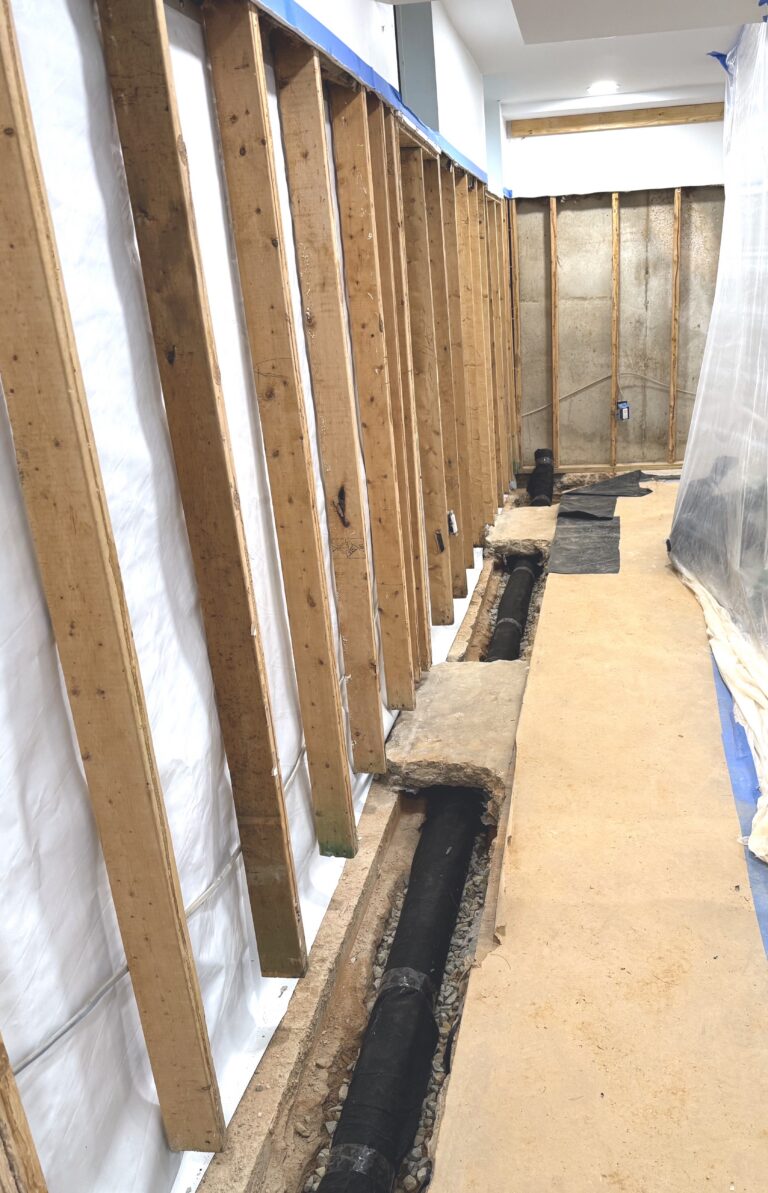
When observations support water reaching the lower perimeter, an interior drain and sump may collect and discharge it. The drain elevation, wall connection, basin, power and backup needs, discharge route, and concrete restoration belong in the design. A sump pump by itself does not necessarily collect water along an entire wall. See our interior drain versus shallow gutter guide for the difference.
Water on an accessible exterior wall
Exterior work can address a defined wall area when access, utilities, excavation safety, and the intended discharge are accounted for. A shallow grading drain and a drain at footing level are different systems; neither depth nor a particular membrane should be assumed from the phrase “exterior waterproofing.” Our interior versus exterior guide compares the questions that determine the right approach.
Humidity without an identified liquid-water leak
Check indoor humidity, condensation, plumbing, and HVAC sources before installing a drain. Drying or dehumidification may help comfort, but it will not repair an active water entry route. The EPA emphasizes controlling moisture when addressing mold; see its moisture-control guidance.
How much time and what disruption should I expect?
There is no reliable project duration from a symptom alone. Work length depends on the measured run, access, utilities, foundation material, interior finishes, excavation conditions, discharge route, permits where applicable, and restoration scope. For a finished basement, ask exactly which flooring, trim, drywall, or framing must be opened and which finishes are included in the written scope.
What should an Ashburn waterproofing estimate specify?
- The observed water path and any uncertainty that remains.
- What is being collected or blocked, and at what approximate elevation.
- The route and endpoint for every drain, downspout, or sump discharge.
- Equipment, power, backup, and maintenance responsibilities if a pump is proposed.
- What the crew will remove, restore, test, and document.
- The written warranty terms for the actual proposed scope, rather than a generic promise.
A small localized repair and a full perimeter system are not interchangeable price categories. Compare written scopes, not just totals. Our waterproofing-cost guide explains the cost drivers without pretending that one price fits every home.
Questions Ashburn homeowners often ask
Does a musty smell mean I need an interior French drain?
No. The smell indicates a moisture concern, but it does not identify the source. Check for liquid water, leaks, condensation, and humidity before selecting drainage.
Is interior or exterior waterproofing better?
Neither is automatically better. The choice depends on the source and entry point, foundation type, exterior access, drain elevation, discharge route, and finished-space disruption.
Can I extend a downspout myself?
Simple surface extensions may be appropriate if they move water to a suitable location. Buried routing and shared-lot drainage need a checked slope and outlet; an extension that merely shifts water to a different low spot may not solve the problem.
Will a sump pump guarantee a dry basement?
No pump is a substitute for identifying and collecting the relevant water path. Capacity, power, backup, maintenance, and safe discharge matter. Ask what will be tested at completion and what the written scope actually covers.
Schedule an Ashburn basement inspection
DMV Waterproofing is engineer-founded and serves Ashburn and surrounding Loudoun County communities. We inspect the water path, explain what is observed and what remains uncertain, and propose a scope suited to the property. See our basement waterproofing service or request an inspection through the site.