

Is the lawn still soggy after rain, or does water run toward the basement door? “Yard drainage” is not one product. The right fix depends on where the water begins, whether it is surface runoff or water in the soil, and where it can leave the property safely.
For homeowners in Maryland, Northern Virginia, and Washington, DC, start by watching the water path during a storm. A French drain can be useful, but a buried pipe is not a substitute for correcting a downspout that empties beside the house or a slope that points toward the wall.
Why does water stand in my yard after rain?
Common causes include a low spot, compacted or slow-draining soil, runoff from a roof or paved surface, an obstructed outlet, or grading that sends water toward the house. A wet patch beside one downspout suggests a different source than a broad area that stays wet after the rest of the yard dries. Mark the wet area, photograph it during rain, and note how long it remains. Those observations are more useful than assuming every soggy lawn needs the same trench.
The U.S. Department of Energy recommends directing roof runoff and surface water away from foundations. This is especially relevant when a yard problem is also causing basement leakage. See its guidance on gutters and downspouts.
What should be checked before a drain is designed?
- Source: roof, neighbor runoff, paved area, low spot, or groundwater?
- Route: which way does the land slope, and where does water collect first?
- Outlet: can collected water move by gravity to a suitable discharge point?
- Existing work: where do old pipes go, and are they blocked, broken, or pitched the wrong way?
- Constraints: utilities, structures, neighboring lots, and local discharge requirements.
A proposal should show the collection point, pipe type, intended slope, and final discharge. “Install a French drain” without a water path or outlet is not a complete design.
Which yard drainage solution fits which water problem?
Downspout routing for roof runoff
If a downspout releases roof water at the foundation, first consider moving that discharge away through a suitable solid pipe or other approved route. Roof water should not be casually tied into a perforated collection pipe beside the foundation. The outlet must be planned so it does not send water back to the house or onto a neighbor.
Regrading or a swale for surface runoff
If rain flows over the surface toward the building, reshaping the grade or providing a swale can redirect it. Compacting the prepared soil and checking the final slope matter: an attractive top layer cannot correct a trench or fill that settles into a reverse grade. See our grading guide for related warning signs.
Catch basin or channel drain for a concentrated flow path
A catch basin can collect water at a defined low point. A channel or trench drain can intercept water crossing a driveway, patio, walk, or basement-entry threshold. Both still need a correctly pitched discharge line and an acceptable outlet.
French drain for water in the ground
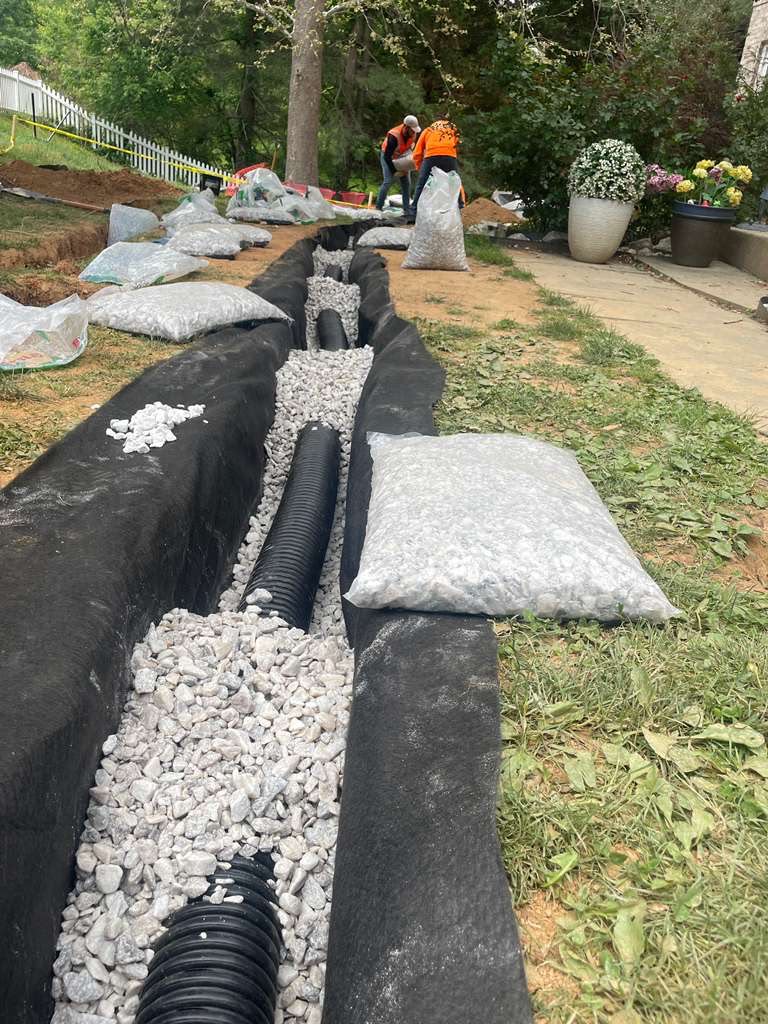
A French drain uses a gravel-filled trench with perforated pipe and filter fabric to intercept water moving through the soil. Its depth and position depend on the problem. A shallow yard drain or grading tile should not be mislabeled a footing drain. The pipe must have a workable outlet; fabric, washed stone, and slope are part of the system rather than decoration.

North Potomac, MD — trench wrapped in filter fabric before stone. DMV Waterproofing crew.
Field photo: a North Potomac trench lined with geotextile before stone placement. This shows a construction stage, not proof of the correct design for every yard.
Dry well or pumping when gravity has limits
Some sites lack a practical daylight outlet. A dry well may be considered only where soil, space, setbacks, and local requirements allow it. A pump can help where gravity alone cannot move a specific collected flow, but it should have a clearly defined role, power plan, and discharge location. Do not add a sump pump by default when a gravity route works.
What do the construction photos show?
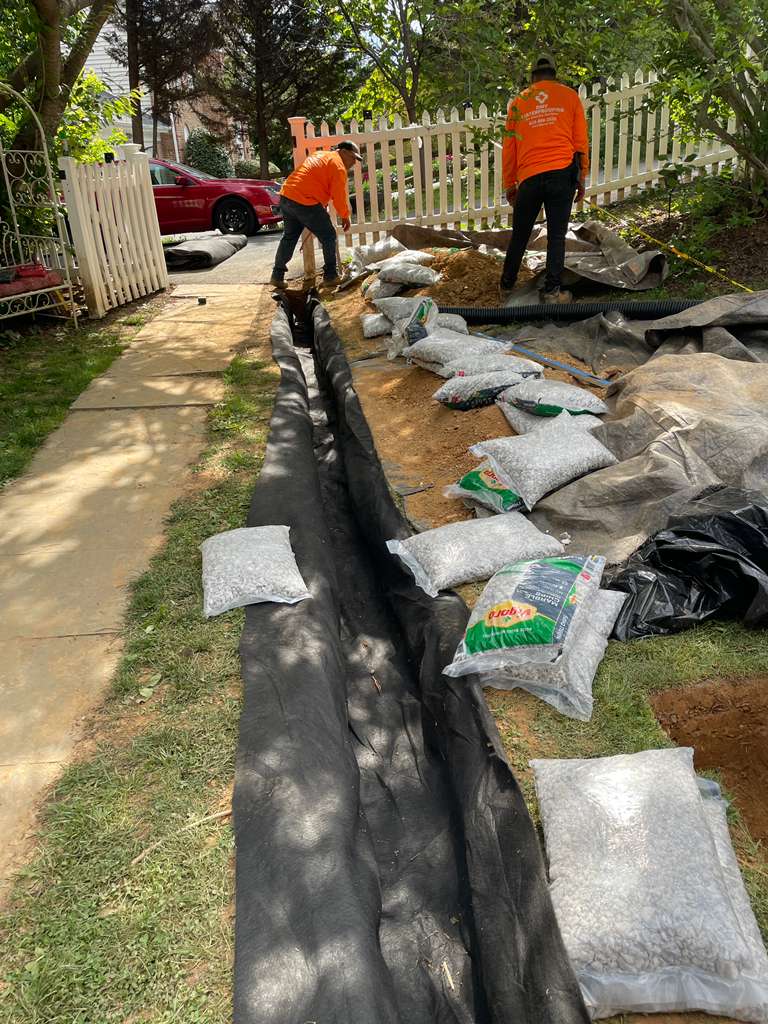
North Potomac, MD — our crew staging washed stone along the open trench.
Field photo: washed stone staged beside the open trench in North Potomac.

North Potomac, MD — catch basin tied into the drain line on our own installation.
Field photo: the catch-basin connection. Photos document the installation stage; they do not replace a written plan showing the final outlet and slope.
Frequently asked yard drainage questions
Will a French drain fix standing water in every yard?
No. If roof runoff or surface slope is the main cause, address that path first. A subsurface drain is useful when it intercepts the water actually causing the problem and has a safe outlet.
Can water be sent to the street or my neighbor’s lot?
Do not assume so. Discharge rules vary by jurisdiction and may depend on the connection and location. Confirm the permitted route before work begins; avoid creating a new problem for another property.
What if a previous drainage company installed a pipe but the basement still floods?
Check whether the pipe collects the right water, has continuous fall, remains open, and ends at a functioning outlet. Also check whether downspouts and grading still direct water toward the house. A prior installation can fail because of routing or slope, not just because a pipe is clogged.
How much does yard drainage cost?
There is no reliable single price without a site-specific scope. Trench length and depth, access, utilities, soil, outlet, hardscape restoration, and whether gravity is possible all affect cost. Compare written designs and discharge locations, not just totals.
Start with the water path, then choose the system
DMV Waterproofing is engineer-founded and uses in-house crews. If water pools near your foundation, lawn, or basement entrance, request an inspection and share photos taken during rain. We can evaluate the slope, roof runoff, existing drainage, and feasible outlet before recommending grading, a drain, or another solution.