

From Our Field Notes · Entry Point 1 of 7
Underground Water DMV Basement — When the Water Table Rises Beneath Your Home
The most common — and least visible — source of basement leaks in the DMV.
Underground water DMV basement is the most common cause of leaks we see in the field — and the hardest one for homeowners to recognize. If you live in the DMV, the ground beneath your home is rarely simple. Most houses across Maryland and Northern Virginia sit on a mix of clay, silt, and fill soil. Clay holds water like a sponge. It doesn’t drain. When rain falls, water doesn’t quickly disappear into the ground — it stays near the surface, soaks into the clay, and lingers.
That matters more than most homeowners realize. Right beneath your basement floor — about three and a half inches under the concrete slab you’re standing on — is that same wet, slow-draining soil. And when groundwater rises in that soil, it doesn’t just sit there politely. It pushes.
This is the most common entry point we see in DMV basements over 20+ years of field experience. It’s also the hardest to diagnose, because the problem starts under your floor — somewhere you can’t see — and only shows itself once the damage above is already underway.
Why DMV Soil Causes Underground Water DMV Basement Problems
The DMV region has soil profiles that are particularly bad for drainage. Most of Maryland and Northern Virginia sits in the Piedmont Plateau, where clay-rich soils dominate. Add in fill soil from decades of development — soil that was trucked in, dumped, and rarely properly compacted — and you get a foundation environment where water moves slowly, unevenly, and unpredictably. The USDA Web Soil Survey is a free tool homeowners can use to look up the soil profile under their own property.
Clay holds water. Silt drains, but compacts and shifts. Fill soil is whatever happened to be available when the lot was graded — often a mix of all three plus construction debris. Two homes built ten feet apart on the same street can have entirely different soil profiles, which is why one neighbor stays dry through a heavy rain while the next door gets a flooded basement.
The First Signs: Differential Settlement
When clay-rich soil holds water under your home, it gets weaker. And here’s the catch — the soil under your home is rarely uniform. One section might be denser native clay, another softer fill, another a pocket of silt. When water saturates these layers unevenly, parts of your foundation sink slightly more than others. That’s differential settlement.
The first warning signs are subtle: hairline cracks in basement walls, drywall cracks above doorways or windows on the first floor, doors that suddenly stick or won’t close evenly, and small gaps opening between baseboards and floors. These are easy to ignore — most homeowners chalk them up to “the house settling.” In a DMV home with poor underlying drainage, they’re often the early symptoms of soil failure caused by underground water.
Clamshell Cracks in the Slab
If groundwater keeps rising, the slab itself starts to crack. We see a very specific pattern in DMV basements — what we call clamshell cracks: cracks that fan out across the floor in curves, often radiating from a central point or running parallel to a wall. That pattern is a fingerprint. It means underground water pressure is pushing up from beneath the slab, and the concrete is cracking in response.
Clamshell cracks aren’t a cosmetic issue. They’re a sign that the soil under your slab is saturated and the slab is no longer being uniformly supported. Water can — and will — start coming through those cracks during the next rain.
When Underground Water Reaches Your Foundation Wall
If groundwater continues to rise, it eventually climbs above the level of your footer. Now we’re not just dealing with water under the slab — we’re dealing with water pressing against the outside of your foundation wall. This is hydrostatic pressure, and it’s measured in pounds per square foot. Even a few feet of water against your wall translates into hundreds of pounds of force per linear foot of foundation.
What happens next depends on what your foundation wall is made of:
- Poured concrete walls: Pressure builds against the wall. Existing weak points — tie rod holes, construction joints, hairline cracks — start to weep water. New cracks may form along stress lines.
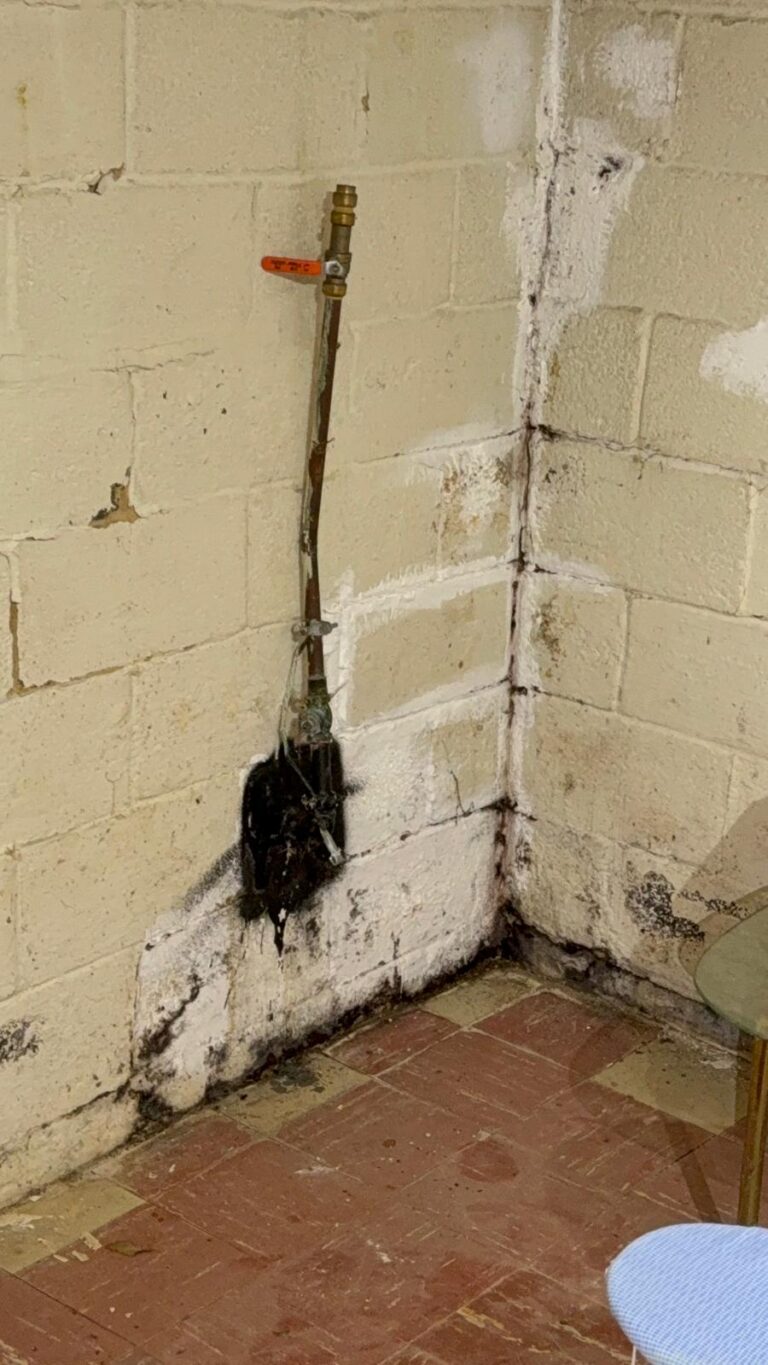
- CMU (concrete block) walls: The most vulnerable type. Concrete blocks are hollow and porous. Water seeps into the blocks themselves, fills the cavities, and shows up inside as wet patches, paint bubbles, white efflorescence, or active mold. Lateral pressure causes step cracks climbing diagonally through the mortar joints. Over time, the wall can bow inward as pressure exceeds what the masonry was designed to resist.
- Brick foundations: Common in older DMV homes built before 1950. The mortar between bricks is the weak point. Water dissolves and erodes the mortar joints over decades, creating channels that let water through and weakening the structural integrity of the wall.
The Cold Joint — A Hidden Entry Point
Even before water makes it through the wall itself, there’s a horizontal seam where your foundation wall meets the footer it sits on. This is the cold joint, and it’s almost never waterproofed properly because it was designed as a structural connection, not a sealed surface.
When the water table rises behind your wall, the cold joint is often the first place underground water finds its way in. You’ll see it as a wet line along the floor-wall corner, especially after heavy rain. We covered this in detail in Entry Point #2 of this series.
Why Drainage Matters More Than the Pump
Here’s where we have to be direct with homeowners: a sump pump alone is not a drainage system. The pump only works on water that reaches the pump. If the channels feeding it are clogged, broken, or never existed in the first place, the pump can run all day and your basement will still leak.
A real interior drainage system has two parts:
- Drainage channels beneath your slab that catch water before it can pool under your foundation, then route that water toward a sump pit.
- A sump pump that pumps the water up and out, away from your foundation.
In many DMV homes — especially homes built before the 1980s — these drainage channels either don’t exist, are clogged with sediment, or have lost their slope due to settlement. The water can’t reach the pump anymore. So even with a brand new high-capacity sump pump, the soil under your home stays saturated, the cycle of pressure and seepage continues, and the homeowner can’t figure out why a “working” pump isn’t keeping the basement dry.
A common misconception: Many homeowners assume that if the sump pump is running and discharging water, the drainage system is healthy. The truth is more complicated — a pump can run on water entering the pit from very localized sources while the rest of the underground drainage network has failed completely. We’ll cover how to actually test whether your drainage system is working in a future field note.
That’s why we don’t just install a sump pump. We rebuild the system that feeds it — opening up working drainage channels beneath the slab so water can actually move where it needs to go. Fixing the pump without fixing the channels solves nothing.
The Real Solution Comes From Diagnosis
Underground water is rarely something you can fix from above. Painting the walls with waterproof sealant, applying patches at the cove joint, or upgrading to a more powerful pump won’t address what’s happening beneath the slab. The water is coming from under your foundation, and the solution has to work at that level.
What works depends on the home: sometimes it’s an interior drainage system tied to a properly sized sump pump, sometimes it’s exterior excavation and a new perimeter drain, sometimes it starts with fixing the upstream causes (grading and gutters, covered in entry points #6 and #7). Most of the time, it’s a combination — and the right combination only becomes clear after a real diagnosis.
Free Inspection
Suspect underground water in your basement?
Our engineer-founded team has been diagnosing groundwater issues across the DMV for over 20 years. Schedule a free inspection — we’ll check your slab, your foundation walls, and your existing drainage system to tell you exactly what’s happening beneath your home.
Next in this series
Entry Point #2: The Cold Joint — Why Water Sneaks In at the Floor-Wall Corner →
Why the seam between your footer and foundation wall is one of the first places water gets through — and why hydraulic cement patches almost never hold.
About DMV Waterproofing: Engineer-founded in 2005 by two UDC civil engineering graduates who began their careers as foundation field inspectors at ECS Limited. Based in Rockville, Maryland, with branches in North Bethesda, Ashburn, and Manassas. Over 20 years of field experience across the DMV. No subcontractors — every job done by our in-house crews.


