

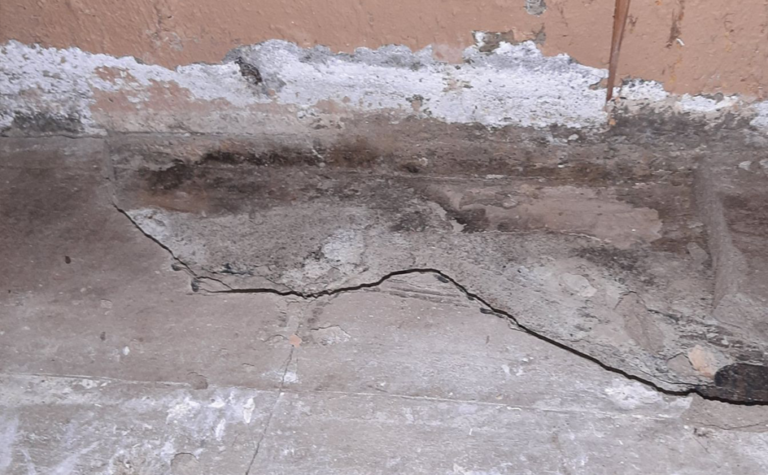
A crack in a basement floor is a clue, not a diagnosis. Some cracks occur as concrete cures; others appear with water entry, slab displacement, or changes elsewhere in the home. What matters most is whether the crack is changing, whether the two sides remain level, and whether water or other warning signs appear with it.
This homeowner guide explains what to record, when to seek a professional evaluation, and why sealing the visible line does not always solve the cause. A photograph alone cannot establish whether a foundation is structurally sound.
When should a basement floor crack concern you?
- It is changing: the crack is getting longer or wider, or a new crack appears nearby.
- The slab is uneven: one side is higher than the other, a section is sinking, or the floor is visibly heaving.
- Water is entering: dampness, seepage, or puddles repeatedly appear at the crack or floor-wall joint.
- Other parts of the house change: wall cracks, a bowing basement wall, sticking doors, or new gaps appear at the same time.
- There is a safety concern: rapid movement, a visibly unstable wall, or an active electrical or flooding hazard needs prompt professional attention.
There is no single crack-width number that can safely classify every floor crack. Condition, movement, water, and the surrounding structure matter more than a number taken out of context.
What can cause cracks in a basement slab?
Concrete can shrink as it cures. Slab cracks can also be associated with changes in the support beneath the floor, movement of the slab, water pressure, or an existing joint. The basement floor and the load-bearing foundation are related but not identical elements: a crack in the floor does not automatically mean the wall or footing has failed.
Water can travel through openings and joints, and moisture can move through porous concrete. The U.S. Department of Energy describes both bulk-water entry and capillary moisture movement as foundation concerns. That is why a wet floor crack calls for tracing the water source, not simply painting over the surface. Read the DOE foundation moisture guidance.
How can I document a crack before an inspection?
- Take a wide photo showing where the crack sits in the room and a close photo with a ruler for scale.
- Record the date and note whether the floor was dry, damp, or actively leaking.
- Check whether the crack edges are flush or offset. Do not force tools into the crack.
- Note recent heavy rain, plumbing leaks, drainage changes, or prior repairs.
- Repeat photos from the same position if you suspect movement.
These observations help an inspector distinguish a persistent water path from a one-time event and decide whether structural evaluation is needed.
Does a wet crack require a sump pump?
Not automatically. First establish whether water is entering through the slab crack, at the floor-wall joint, from a plumbing leak, or from another path. Check the outside grading, gutters, and downspout discharge as well. Some homes need exterior water management; others may require an interior collection system. A pump makes sense only when the selected system needs it and its discharge can be routed safely. See our guide to how water enters a basement.
Is sealing the crack enough?
For a dry, stable, non-displaced crack, a suitable repair may close the opening after the cause is understood. If water keeps returning, a surface patch alone can hide rather than solve the water path. If slab movement is active or the crack aligns with other structural symptoms, have the condition evaluated before selecting a filler or finish.
A repair proposal should state the observed condition, the likely cause, what will be done, how water will be managed if present, and what conditions are outside the scope. Do not assume a product name is a complete repair plan.
What about radon and floor cracks?
Radon can enter through openings in a foundation, but no one can identify an elevated radon level by looking at a crack. The U.S. Environmental Protection Agency says testing is the way to know whether a home has a radon problem. If radon is a concern, use an appropriate test and a qualified radon professional; basement waterproofing is not a substitute for radon testing or mitigation. See EPA radon guidance.
Frequently asked questions about basement floor cracks
Are hairline cracks in a basement floor normal?
Fine cracks can occur in concrete, but their appearance alone does not prove the cause. Monitor them and seek evaluation if they change, leak, or appear with displacement or other symptoms.
Should I repair a crack before finishing the basement?
Investigate active moisture and movement first. Covering a wet or changing crack with flooring can conceal the evidence and damage the new finish.
Does a crack that reaches the wall mean the house is settling?
Not necessarily. The relationship between the slab, wall, and any movement has to be checked on site. If the wall also cracks, bows, or leaks, request a fuller evaluation.
Who should inspect a basement floor crack?
A waterproofing inspection can trace moisture and drainage. Displacement, ongoing movement, or signs of structural distress warrant assessment by a qualified structural professional. One problem may require both kinds of evaluation.
Get the cause right before choosing a repair
DMV Waterproofing is engineer-founded and uses in-house crews across Maryland, Northern Virginia, and Washington, DC. If your basement floor crack leaks or changes, request an inspection and share dated photos. We can evaluate the water path and explain whether waterproofing work, additional monitoring, or a structural assessment is the appropriate next step.