

DMV Foundation Types: 4 Critical Basements We See Every Day

What’s Your DMV Foundation Made Of? The 4 Types We See Every Day

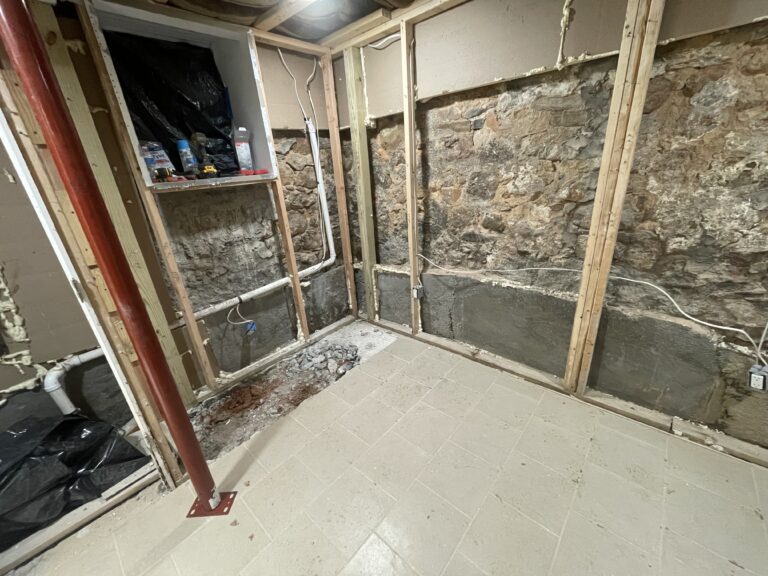
DMV foundation types — CMU, poured concrete, brick, and stone basement walls

Post #1 in the DMV Waterproofing Field Notes series. If you haven’t read our open letter yet, start there.

This post is about DMV foundation types — what your foundation is actually made of, and why that matters more than almost any other question you can ask about your basement. Because every foundation type fails differently, leaks differently, and needs a different repair strategy. The same $15,000 exterior waterproofing job that saves a brick house can crack a stone wall in half. The same crack injection that seals a poured concrete wall is useless on a CMU block. Understanding your foundation is the first step to understanding your water problem.

Across the DMV — DC, Maryland, and Virginia — we see four DMV foundation types over and over. Here they are, in order of how often we find them.

DMV Foundation Types #1: CMU Block (Cinder Block)

If you own a suburban home built between the mid-twentieth century and the early 2000s, there’s a good chance your basement walls are CMU — concrete masonry units, commonly called cinder block. This is by far the most common foundation type we walk into across Rockville, Ashburn, Manassas, and the surrounding suburbs.

How CMU fails: Unlike solid concrete, CMU is hollow. Each block has internal voids. Water that gets through the mortar joints or damaged block faces collects inside the wall. That trapped water is the source of almost every CMU problem we diagnose.

The weak points are predictable:

  • Mortar joint failure. Mortar is porous by nature. Over decades, water moves through it, carrying dissolved minerals and acids, slowly eroding the bond.
  • Step cracks. A staircase-pattern crack running along mortar joints. When we see a step crack, we immediately think hydrostatic pressure — and we look for differential settlement in the structure above.
  • Horizontal cracks. These are more serious. They indicate lateral pressure from the soil outside, often from expansive clay or a high water table pushing against the wall.
  • Damaged blocks. Freeze-thaw cycles, impact, or long-term moisture saturation can crumble the block face itself.

The mold problem nobody talks about. Because CMU blocks are hollow and porous, they hold water for a long time. A wall that looks dry on the surface may still be saturated inside.

That trapped moisture breeds mold — and not just surface mold. Mold grows inside the blocks, behind paint, inside the cavities. It affects indoor air quality and can cause real health problems.

Here’s where most homeowners get bad advice: they’re told to paint the inside of the wall with a “waterproof” sealer like Drylok. This is exactly the wrong thing to do. Sealing the interior surface of a CMU wall traps the water inside the block. The wall can’t breathe, can’t dry, and the mold problem gets worse — not better.

Let the wall breathe so it can dry. Trapping the moisture does not eliminate the mold; it hides it while the problem grows.

What actually works on CMU:

  • Exterior waterproofing. If the water is coming from rainfall, grading, or saturated soil against the wall (not from high water table below), full exterior waterproofing is the best solution. We excavate to the footing, apply a waterproof membrane, add protection board, and backfill properly. The water never reaches the wall at all. The structure is preserved. The wall can dry from the inside.
  • Crystalline cement-based coatings applied on the wall surface after exterior waterproofing is complete. These coatings let the wall breathe while providing an additional moisture barrier — the opposite approach of plastic-based sealers.
  • Surface patching for damaged blocks and failing mortar joints. CMU does not accept crack injection the way poured concrete does.
  • Interior drain tile and sump pump when the water is coming from below — when hydrostatic pressure is pushing groundwater up through the footing.

DMV Foundation Types #2: Poured Concrete

Poured concrete foundations are the most common in newer DMV construction. They’re monolithic — one continuous wall of concrete, no mortar joints, no hollow cavities. Stronger than CMU by design, and when installed correctly, much more watertight.

But “correctly” is the key word. Poured concrete walls have three specific failure points we see constantly.

Cold joints. When concrete is poured in two separate pours — usually at the footing-wall junction — the two concrete masses don’t bond perfectly. That interface is called a cold joint, and it’s the most common leak path we find in poured concrete foundations. Water exploits the seam between the old and new concrete.

Vertical cracks. Concrete shrinks slightly as it cures, and temperature changes cause it to expand and contract year after year. Small vertical cracks form. Most are cosmetic. But if they extend through the full thickness of the wall, they become a direct path for groundwater.

Form tie holes. This is one of the most overlooked failure points in the industry. When a poured concrete wall is built, metal ties hold the forms in place. After the concrete cures, the forms are removed, leaving small metal remnants embedded in the wall.

These are supposed to be ground down, epoxy-coated, and patched with repair mortar. Almost no one does this properly. The metal remnants start to corrode. Water gives life to soil, but water kills steel. As the ties rust, they expand and crack the surrounding concrete from the inside out.

Ten or fifteen years later, water starts seeping through what used to be a sealed wall. The source? A form tie that nobody finished correctly the day the wall was poured.

What works on poured concrete:

  • Crack injection with polyurethane grout. For a vertical crack where water is entering, we inject polyurethane grout from the interior. The grout fills the full thickness of the crack, remains flexible, and seals the path. Critical point: crack injection is only used on poured concrete. It does not work on CMU, brick, or stone walls because those walls are not monolithic — there’s nothing for the grout to seal against.
  • Exterior crack repair with flexible sealant. If the crack is accessible from outside and we can excavate to it, we repair from the outside — always with flexible material so that any future movement keeps the seal closed.
  • Partial or full exterior waterproofing. When there’s no severe pressure from below and the issue is surface water entering through cracks or cold joints, exterior waterproofing preserves the structure and solves the problem at its source.
  • Interior drain tile and sump pump when hydrostatic pressure is the real cause — when water is pushing up from the footing level regardless of what you do to the wall above.

DMV Foundation Types #3: Brick Foundation

Brick foundations are less common today but still abundant in the older sections of DC, downtown neighborhoods, and historic districts across the region. Many of these homes are a hundred years old or more.

Brick itself is surprisingly durable — fired clay is one of humanity’s oldest building materials, and it resists a great deal of weather. But brick cannot survive constant water exposure. And the real weakness in a brick foundation isn’t the brick. It’s the mortar.

Here’s what happens over a century of water exposure. Mortar is cement-based and inherently porous. Rainwater is slightly acidic. Water passing through soil picks up minerals, salts, and nitrogen. (The USDA Soil Survey confirms most DMV soils sit on mineral-rich clay and silt loam.) Over years and years and years, this acidic, salt-laden water moves through the mortar joints. It dissolves the mortar from the inside.

The bond weakens. Water penetrates deeper. The cycle accelerates. We also see damaged bricks — cracks, spalled faces, and brick degradation in the sections of wall that have been saturated the longest.

What works on brick foundations:

Exterior waterproofing is the right approach for brick — but it’s a layered process because the wall surface is not flat:

  1. Fine crack repair with cement-based material.
  2. Tuckpointing — removing the failed mortar and replacing it with new cement-based mortar, joint by joint, where needed.
  3. Cement-based parging. A continuous coating of cement-based waterproofing is applied over the entire wall surface. This does two things: it fills the mortar voids and creates a flat, uniform surface. It also protects the brick itself from further water contact.
  4. Sheet membrane. Now that the surface is flat, a continuous waterproofing membrane can be applied over the parging.
  5. XPS protection board. An extruded polystyrene board protects the membrane during backfilling.

This is more work than poured concrete or CMU exterior waterproofing, but it’s necessary. Skip any of these steps on a brick foundation, and the system fails within a few years.

DMV Foundation Types #4: Stone Foundation

Stone foundations are the rarest type we work on, but they’re still out there — especially in historic buildings, downtown DC, Georgetown, Old Town Alexandria, and the oldest sections of Maryland and Virginia. Many of these foundations were built before 1900. Some are much older.

A stone foundation is a gravity wall — a wall that holds itself up by its own weight. The same engineering principle used to build the pyramids. When built correctly, these walls can last for centuries.

But they’re difficult to maintain. The surface is even less uniform than brick. Large stones, small stones, corner stones, filler stones — no two are the same.

The good news: stone itself doesn’t conduct water the way mortar does. The bad news: if there’s no waterproofing system and no drainage behind the wall, you have the same problem as every other foundation type — water gets in, over and over, for a century.

Exterior waterproofing on a stone wall is possible, but challenging. It follows the same layered approach as brick — parging to create a flat surface, membrane, protection board. The historic preservation concern is also real: some of these buildings are protected, and any exterior work must be done carefully.

For these reasons, interior drainage systems with a sump pump are often the more practical choice on stone foundations. It solves the water problem without touching the historic exterior.

The One Critical Rule for All DMV Foundation Types

No matter what your foundation is made of — concrete, CMU, brick, or stone — the direction of the water decides the direction of the solution.

If water is pushing up from below — high water table, hydrostatic pressure from the footing — you need an interior drain tile and sump pump system. No exterior repair will stop groundwater rising from beneath your home.

If water is coming from outside — saturated soil against the wall, a downspout dumping at the foundation, negative yard grading, rainwater finding cracks and joints — exterior waterproofing is the right answer. Stop the water at the source, before it ever reaches the wall.

Most homes with water problems have one or the other. Some have both. The only way to know which your home is dealing with is a proper inspection — not a sales visit.

Now Go Look at Your Basement

Take five minutes. Go down to your basement, look at the walls. Are they poured concrete? Hollow block? Brick? Stone? That’s step one in understanding your home.

Next week, we’ll talk about what’s under your foundation — the soil it sits on, the water table beneath it, and why two identical homes on the same street can leak completely differently.

— The founders of DMV Waterproofing


Want a Free Inspection?

We offer free, no-obligation inspections across DC, Maryland, and Virginia. No subcontractors, no sales pressure — just a diagnostic walk-through by someone who has been inspecting and waterproofing DMV basements since 2005.

Schedule Your Free Inspection

Or call 1-833-888-2533 to speak with a project manager directly.

Leave A Comment

Your email address will not be published. Required fields are marked *

x

Free Inspection

Blank Form (#3) (#4)