

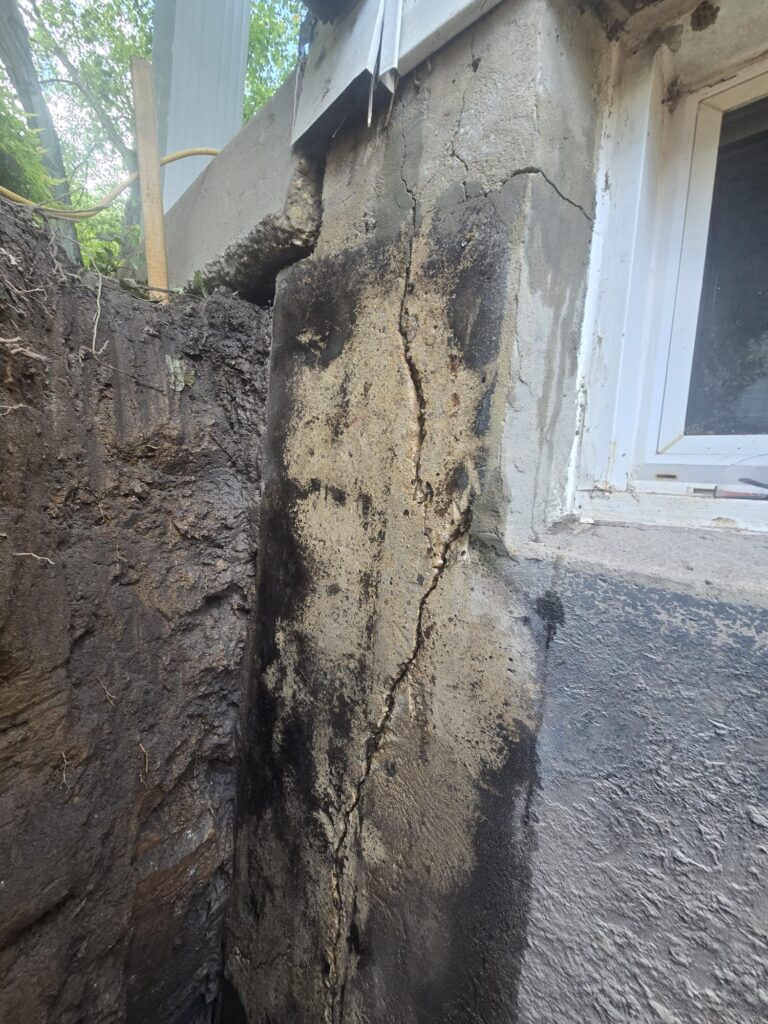
A crack in a Rockville basement wall deserves a careful look, especially when it changes, leaks after rain, or appears with wall movement. Its shape alone cannot tell you whether the cause is shrinkage, settlement, lateral pressure, a construction joint, or a separate water path. The first step is to identify the wall material, document what is changing, and trace where water appears.
Field photo: an exposed foundation wall with a visible crack during a separate Rockville exterior-waterproofing job. The image documents the opening, not its cause.
What should you record before a foundation-crack inspection?
- Location and wall type: Is the opening in poured concrete, CMU block, brick, stone, mortar, or a finish layer?
- Pattern and change: Photograph the crack with a ruler and note whether its width or the wall alignment changes over time.
- Water timing: Does moisture appear during rain, snowmelt, or while a plumbing fixture runs? Where is the first wet spot?
- Outside conditions: Check gutters, downspouts, grading, window wells, patios, and the location of any drain discharge.
- Movement signs: Note bowing, displacement across the crack, sticking doors or windows, and separation at adjoining surfaces.
If water is near electrical equipment, keep clear and seek qualified help. If the wall is visibly moving or unstable, ask a qualified structural professional to evaluate it promptly. A photo or a single width measurement is useful documentation, not a structural diagnosis.
Does the crack pattern tell you the cause?
Not by itself. A vertical opening in poured concrete may be associated with shrinkage, movement, or water entry. A stair-step line follows mortar joints in masonry, but it does not by itself prove settlement or hydrostatic pressure. A horizontal crack or bowing wall deserves particular attention because it may be associated with lateral movement. Width, displacement, change over time, moisture, and the whole wall condition matter more than one label. Our DMV foundation-type guide explains why repair choices differ by material.
Could the leak be coming from somewhere else?
Yes. Roof water discharged beside the house, a window well, a pipe penetration, the wall-floor joint, plumbing, or condensation may be the visible source even when a nearby crack attracts attention. Soil and groundwater conditions vary from lot to lot. Rockville’s ZIP code or a regional soil map cannot establish the water pressure at one foundation. Our soil and water-table guide describes that limitation.
Which repair fits a Rockville foundation crack?
A localized, nonmoving crack in poured concrete
After the crack and water route are evaluated, polyurethane injection may be considered for a suitable leaking opening. The scope should state how the crack is prepared, how material is placed, how the surface is finished, and what is and is not covered. Injection addresses that opening; it does not automatically correct exterior runoff or a moving wall.
A leaking CMU, brick, or stone wall
Water can travel through mortar joints, hollow block, or a wall-floor connection rather than one visible line. An injection method intended for a poured-concrete crack should not be assumed to solve a masonry wall problem. Depending on safe access and the observed water route, an exterior wall repair, surface-drainage correction, or an interior collection system may be considered. A shallow grading drain and a footing-level drain are different systems at different elevations. The proposal should identify the intended collection level and a safe outlet.
Evidence of wall movement
Sealing a crack does not stabilize a wall. Bowing, leaning, displacement, or continuing change calls for structural assessment before selecting reinforcement or reconstruction. Carbon fiber, anchors, excavation, and wall replacement are not interchangeable products; their use depends on the actual wall, loads, access, and design. Foundation repair services should begin with that evaluation.
When is drainage part of the answer?
Only when the observed water route supports it. First trace roof runoff and surface grading. If water is reaching the lower wall or beneath the slab, an interior drain and sump or an appropriate exterior drainage system may be proposed. The plan should specify pipe elevation, connection to the wall, discharge location, restoration, and how the installation will be checked. A crack repair and a perimeter drain solve different problems; neither should be sold solely because a wall has a stain. For more detail, see our interior-versus-exterior guide.
How long will repair take and what will it cost?
A reliable duration or price requires an inspection and a defined scope. Crack length, wall material, moisture, movement, access, utilities, excavation, drainage, finish removal, and restoration all matter. Ask for a written proposal that distinguishes inspection findings from assumptions and lists the repair area, method, discharge if needed, cleanup, verification, and applicable warranty terms. Do not compare an isolated injection with a structural wall repair as if they were the same job.
Questions Rockville homeowners ask
Is every stair-step crack an emergency?
No single pattern proves imminent failure. A widening or displaced crack, visible bowing, or other movement should be evaluated promptly. A stable crack still needs review if it leaks or changes.
Can I cover the crack with paint or hydraulic cement?
A surface patch may hide the opening but cannot establish whether water or movement continues behind it. Document the condition first and identify the source before choosing a repair.
Will injection solve a block-wall leak?
Not automatically. A poured-concrete crack injection should not be generalized to CMU or brick. Masonry walls need their water path, joints, and access assessed separately.
What should I ask about a warranty?
Ask which exact area and failure mode are covered, for how long, what maintenance is required, and whether another water path or wall movement is excluded. Get those terms in writing for the proposed method.
Request a foundation inspection in Rockville
DMV Waterproofing is engineer-founded and serves Rockville and nearby Montgomery County communities. We document the crack, check the surrounding water routes and wall condition, then explain which observations support a repair recommendation and which questions remain open. Request an inspection or call 1-833-888-2533.