

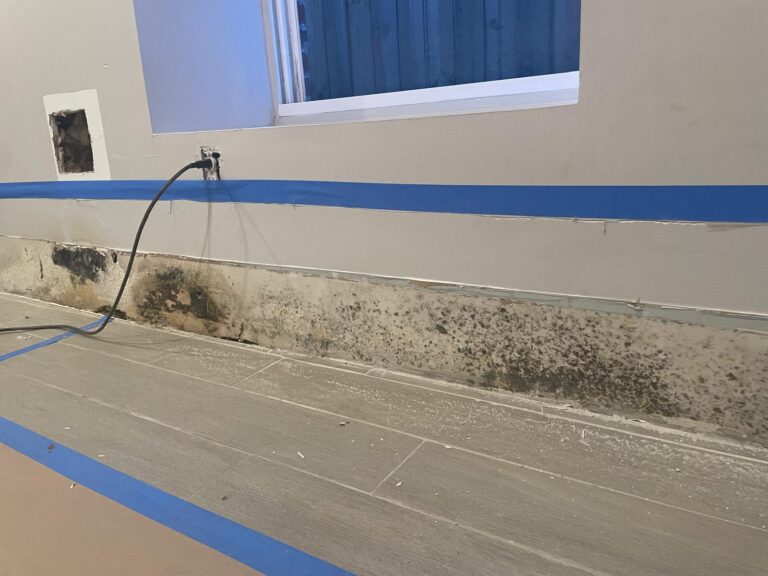
If you searched for “mold mildew remover,” you probably found dark patches somewhere in your home and wanted them gone. That’s a reasonable starting point – but in a DMV home, it’s almost never the whole answer.
In our DMV inspections, a recurring pattern is visible growth returning after a surface has been cleaned. The cleaning may remove what you can see, but if the area stays damp, the underlying moisture problem remains.
In this guide, we’ll show you when a store-bought mold mildew remover is actually enough, when it isn’t, and what to do instead in a DMV home where moisture is almost always the real culprit.
Key Takeaways
- Cleaning can remove visible mold from hard surfaces, but it does not fix the moisture source.
- In bathrooms, on tile, with good ventilation, a remover may be all you need.
- In DMV basements and crawl spaces, mold is a moisture symptom – clay soil, water table, and humidity drive it.
- If the moisture source remains, mold can return after cleaning.
- The correct sequence is: find the source → fix the moisture → then remediate.
- EPA says many areas smaller than about 10 square feet can be cleaned by the homeowner; larger or complex problems require more careful guidance.
What a Mold Mildew Remover Actually Does
Products sold as mold removers vary. For hard surfaces, EPA recommends scrubbing off mold with detergent and water, then drying the surface completely. EPA does not recommend bleach as a routine mold-cleanup method; killing mold alone is not enough because dead mold may still trigger allergic reactions.
Here’s what they do well:
- Help clean visible growth from hard, non-porous surfaces when used as directed.
- Improve the appearance of some surface staining; discoloration may remain after cleanup.
- Require product-specific contact times and safety precautions listed on the label.
Here’s what they don’t do:
- Reliably clean mold from absorbent materials such as drywall, insulation, or carpet; EPA notes these materials may need removal and replacement.
- Stop new mold from growing if moisture is still present.
- Address spores already circulating in your indoor air.
The EPA’s mold guidance is explicit on this point: cleaning without controlling moisture is a temporary fix.
When a Mold Mildew Remover Is Actually Enough
There are three honest scenarios where a spray bottle solves the problem:
1. Bathroom tile and grout, with working ventilation. A bathroom mold patch on glazed tile, with an exhaust fan that actually vents outside, is usually a surface problem. Clean and dry the surface, and use an exhaust fan that vents outdoors. If growth returns, investigate the moisture source.
2. A small isolated patch under 10 square feet on a hard surface. EPA says that in most cases a moldy area smaller than about 10 square feet can be handled by the homeowner. Follow its cleanup guidance, dry the area completely, and address any recurring moisture.
3. After you’ve already fixed the moisture problem. If you’ve sealed a leak, fixed grading, or installed a dehumidifier, a remover is the right last step to clean up what’s left. Without that fix first, you’re just pressure-washing a leaking dam.
When It’s Not Enough – The DMV Reality
Mold growth requires moisture. In a basement, crawl space, or concealed wall cavity, the source may be leakage, ground moisture, or condensation; the source must be identified before choosing a repair.
Clay soil holds water. The Piedmont clay across most of Montgomery, Loudoun, and Fairfax counties saturates after rain and presses moisture against foundation walls for days. We covered this in detail in our DMV soil and water table breakdown – two identical houses leak differently because of what’s underneath them.
Groundwater conditions vary. At some properties, seasonal groundwater and saturated soil can increase pressure around foundation walls. Our post on underground water in DMV basements explains the mechanism.
Summer humidity does the rest. From June through September, outdoor dew points in the DMV regularly exceed 70°F. Warm humid air entering a cool basement condenses on every surface – walls, ducts, joists. That condensation feeds mold even when there’s no visible leak.
In any of these conditions, a mold mildew remover is treating the symptom. The mold returns because the moisture never left.
How to Tell Which Situation You’re In
A simple field test we use on inspections:
| Sign | Probably Surface Only | Probably Moisture Problem |
|---|---|---|
| Location | Bathroom, kitchen, laundry | Basement, crawl space, behind wall |
| Surface | Tile, glass, sealed grout | Drywall, wood, insulation, concrete |
| Pattern | Single patch | Multiple spots or returns after cleaning |
| Size | Under 10 sq ft | Over 10 sq ft or spreading |
| Ventilation | Active exhaust fan working | No ventilation, musty smell persists |
| Recurrence | First time | Came back within 30 days of cleaning |
If you fall on the right side of any of these rows, a mold mildew remover alone won’t hold.
The Correct Sequence: Source → Fix → Remediate
When mold is moisture-driven, the order matters. Skip a step and the mold comes back.
Step 1 – Find the source. Where is the water coming from? Bulk water from a leak or grading problem? Vapor from the soil? Condensation from humid air? Each has a different fix. Our pillar on how water gets into a DMV basement walks through the seven common entry points we see in field inspections.
Step 2 – Fix the moisture. Depending on the source, this might mean exterior grading, gutter extensions, an interior drain tile system, a sump pump, vapor barrier, or a dedicated dehumidifier. For crawl spaces, full encapsulation is often the durable answer – we wrote a step-by-step on crawl space encapsulation that covers what each step actually does.
Step 3 – Remediate the existing mold. Now – and only now – does the remover earn its place. With the moisture source closed, surface cleaning actually holds. For porous materials already colonized, removal and replacement is usually required, not cleaning.
Doing step 3 without steps 1 and 2 is the most common mistake we see on follow-up calls.
When to Stop Cleaning and Call a Professional
EPA cleanup guidance and CDC health guidance suggest extra caution in these situations:
- Mold covers more than 10 square feet. For larger areas or extensive water damage, consult EPA’s detailed guidance and consider a qualified professional.
- Mold has spread to porous materials – drywall, wood framing, insulation, carpet. Surface cleaning won’t reach the colonized material.
- You’ve cleaned the same spot more than once and it returned. That’s a moisture problem, not a cleaning problem.
- Anyone in the household has asthma, allergies, or immune compromise. Disturbing mold during DIY cleaning releases spores into the air.
- The smell persists after cleaning. A persistent musty odor can warrant further investigation for concealed moisture or growth.
For DMV homeowners, the most common red flag is the second one – mold that started behind drywall or under flooring, where the moisture source has been working for months.
What We Do at DMV Waterproofing
We’re not a cleaning supply store. We’re an engineer-founded waterproofing and foundation repair company that’s been serving DC, Maryland, and Virginia since 2005, with in-house crews only – no subcontractors.
When mold is a symptom of a moisture problem in your basement, crawl space, or foundation, our mold removal service is paired with the actual fix – drainage, encapsulation, waterproofing, or whatever the inspection reveals. Cleaning the surface with a mold mildew remover without addressing the source isn’t something we sell, because it doesn’t work.
If you’ve cleaned the same patch twice and it’s back, that’s our cue. Free inspection, written estimate, and we’ll tell you honestly if a remover would have been enough.
Call 1-833 888 2533 or email info@dmvwp.com for a free DMV inspection.
FAQ
Does bleach kill mold permanently?
No. EPA does not recommend bleach as a routine mold-cleanup method. On hard surfaces, scrub off the mold with detergent and water and dry completely. Porous materials may need removal. Mold can return if the moisture source remains.
Why does mold keep coming back after I clean it?
Recurring mold in the same location almost always means an active moisture source. In DMV homes, common sources are foundation seepage, crawl space humidity, condensation on cold pipes, or poor exterior drainage. Cleaning without finding the source treats the symptom, not the cause.
Is store-bought mold mildew remover safe to use in basements?
Follow the product label and use appropriate ventilation and protection. Never mix bleach with ammonia or other cleaners. A product cannot prevent regrowth while the underlying moisture problem remains.
When should I call a professional instead of cleaning it myself?
EPA says homeowners can handle many small areas under about 10 square feet, but larger areas, extensive water damage, contaminated water, or suspected HVAC contamination need additional guidance. Ask a health professional before cleanup if anyone has health concerns.
What’s the difference between mold and mildew?
Mildew is a common name for some surface mold. Color and appearance do not reliably tell you the species or the health risk. If you see or smell growth, remove it safely and correct the moisture source.
How do I know if mold is in my walls?
Signs include musty odor without visible growth, discoloration or staining bleeding through paint, peeling or bubbling drywall, and recurring mold in the same area after cleaning. A moisture meter can help locate damp materials, but it cannot confirm mold. If concealed growth is suspected, discuss appropriate inspection and cleanup methods with a qualified professional.