

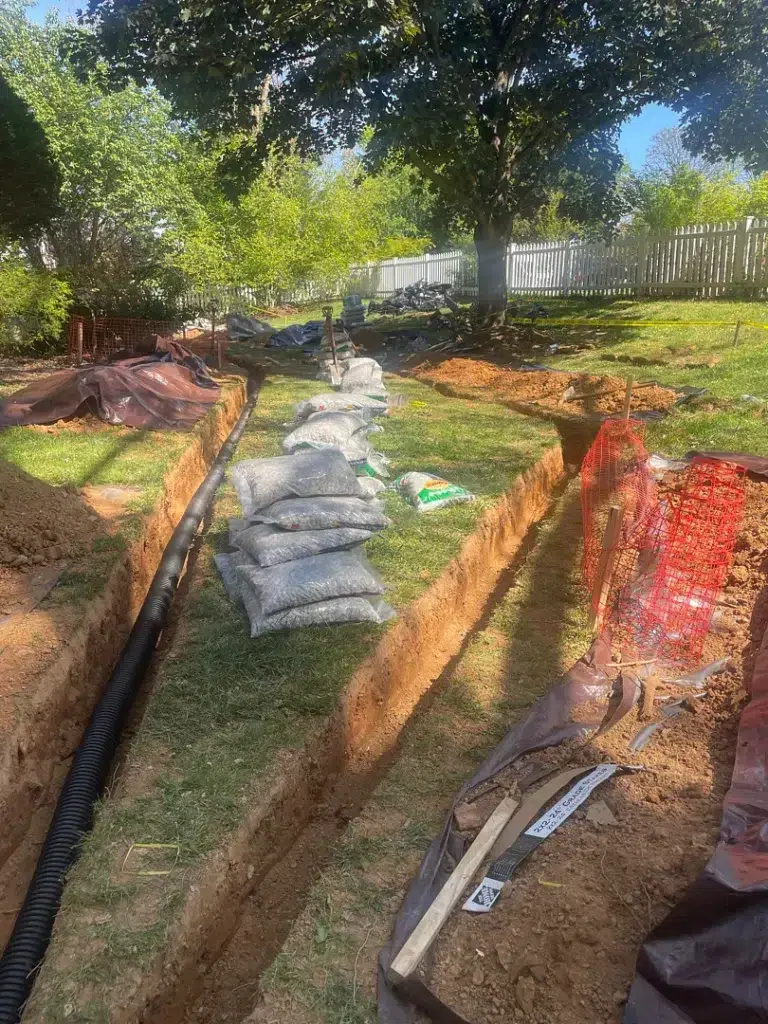
Scope and cost guide based on the same 97-foot project shown in our North Potomac yard-drainage field case. This is a second angle on that job, not a separate project or a price list for every yard.
If you search for “French drain cost,” a price per foot will not tell you whether the quote includes digging, hauling soil away, catch basins, gravel, or putting the lawn back. All were included in this Gaithersburg yard-drain scope.
What was included in this yard French drain?
Our written scope listed 97 linear feet of trench excavation, perforated drain tile, gravel backfill, and surface restoration, plus two 12-inch catch basins. The trench specification was one foot wide and 1.5 feet deep. Excavated soil was to be hauled away, and the disturbed surface restored with grass or mulch. These are the documented scope items; another property needs its own layout and outlet assessment.
The documented project pairs two ways of collecting water: the perforated line receives water in the ground, while the catch basins take in water at the surface. “French drain” and “catch basin” are not interchangeable products.
Which parts of a yard French drain affect cost?
This Gaithersburg scope included more than perforated pipe. It specified excavation and soil hauling, gravel backfill, two catch basins and restoration of the disturbed lawn or mulch. The price for another yard depends on access, trench dimensions, safe discharge and how the surface must be rebuilt. A complete written estimate should name these components, not just a price per foot.
What did the crew observe during heavy rain?
The owner recalls a downpour while the trenches were still open. Water ran along the excavated route away from the house. That was a useful observation of the planned grade, not a post-installation performance test or evidence of how the finished system behaved in later storms.
Why can two French drain quotes differ?
Before comparing totals—or a cost-per-foot number—compare the work behind them:
- Excavation: How long, wide, and deep is the specified trench? Who removes the excavated soil?
- Water collection: Is the design for surface runoff, subsurface water, or both? Are catch basins included where water gathers on top of the ground?
- Drainage path: How is the pipe sloped, and where will collected water go? An outlet must suit the property; this case record does not document an outlet we can describe publicly.
- Backfill and fabric: What material surrounds the perforated line, and how is the trench separated from surrounding soil?
- Finish: Will the contractor restore the disturbed lawn or mulch area, or leave that work to the homeowner?
These questions help you compare scope, not just price. They also reveal when a proposal called a “French drain” is actually only a pipe or a shallow surface channel.
Catch basin or French drain—which solves the problem?
A catch basin takes in surface water at a low point. A perforated yard French drain intercepts water moving through the soil along its route. Some sites need one; some need both. This documented job included both, but that does not mean every wet yard should receive the same system.
An interior French drain is different again: it is a basement drainage system inside the foundation. We would not prescribe one simply because a yard is wet. The first step is to trace where the water is coming from and whether it is actually entering the house. If the source is outside and accessible, exterior drainage or waterproofing may be the more direct answer.
Can this case tell you what your yard will cost?
No single Gaithersburg quote can price another property. Access for equipment, soil removal, depth, water-collection points, a safe discharge route, and the expected finish all change the scope. Ask for a written description of those items before comparing estimates.
This is how we use a real case: not to sell the same trench to every homeowner, but to make the questions behind a yard-drainage quote visible. Diagnose the water path first; choose the system second.