

Case file — North Potomac, Montgomery County, MD. New here? Start with our open letter.
For the written scope and cost drivers behind this same job, see our Gaithersburg-area yard French drain scope guide. That guide is another look at this project, not a separate installation.
At a glance
| Location | North Potomac, Montgomery County, MD |
| The problem | The front yard repeatedly ponded during heavy rain |
| Real cause | The house sits below road grade — runoff had nowhere to go but toward the home |
| The fix | Exterior French drain: graded and compacted trench, geotextile wrap, #57 stone, 6″ perforated pipe, catch basin, gravity discharge to the rear yard |
What the homeowner saw
Every heavy rain, the front yard filled up. Not a damp patch — standing water, wide enough that the owners described it as a lake sitting between the walkway and the house. It would linger for hours after the rain stopped, killing the grass and putting water right up against the foundation.
What we found
The drainage issue was tied to the site elevation; the available photos do not establish the condition of the foundation wall.
This house sits below the grade of the road. Road and uphill runoff could collect in the lower front yard. The owner reported repeated ponding after heavy rain, making surface-water routing the main concern for this drainage project.
A wall coating would not remove standing water from the yard. The team selected an intercepting drain with a gravity route toward the rear; whether regrading alone could have worked would require a measured site plan.
The good news was that the lot had somewhere to send it. The natural fall of the property continued past the house toward the rear yard — open ground, well away from the foundation. We didn’t need a pump or a tie-in. We needed to intercept the water in front and let gravity finish the job.
What we did
We installed an exterior French drain along the front of the property, sized and built to carry real storm volume — not a decorative gravel line.
- Excavated the trench along the line where the water was collecting, in front of the walkway, with the lawn tarped and the work area fenced off.
- Graded the trench bottom to a consistent fall and compacted it with a plate compactor. The photos show a straightedge used to check the fall before the pipe was placed. A consistent trench grade and stable bedding help avoid low spots where water can collect.
- Lined the trench with geotextile fabric, wrapped up both sides. The fabric lets water pass but keeps soil fines out of the stone. Filter fabric helps limit soil fines entering the stone voids.
- Set 6″ perforated pipe on a bed of #57 washed stone, following the grade we’d established, then covered it with more #57 and closed the fabric over the top — a full “burrito” wrap.
- Installed a catch basin on the line to take surface water directly, so ponding at the low spot is captured before it ever spreads across the yard.
- Discharged to the rear yard by gravity, following the property’s natural fall — no pump, nothing to fail, nothing to maintain.
- Restored the surface — the flagstone walkway reset with its river-rock border, and the disturbed lawn regraded and strawed.
Our own crews did all of it. No subcontractors.

The trench, cut along the line where the water was collecting in front of the walkway.
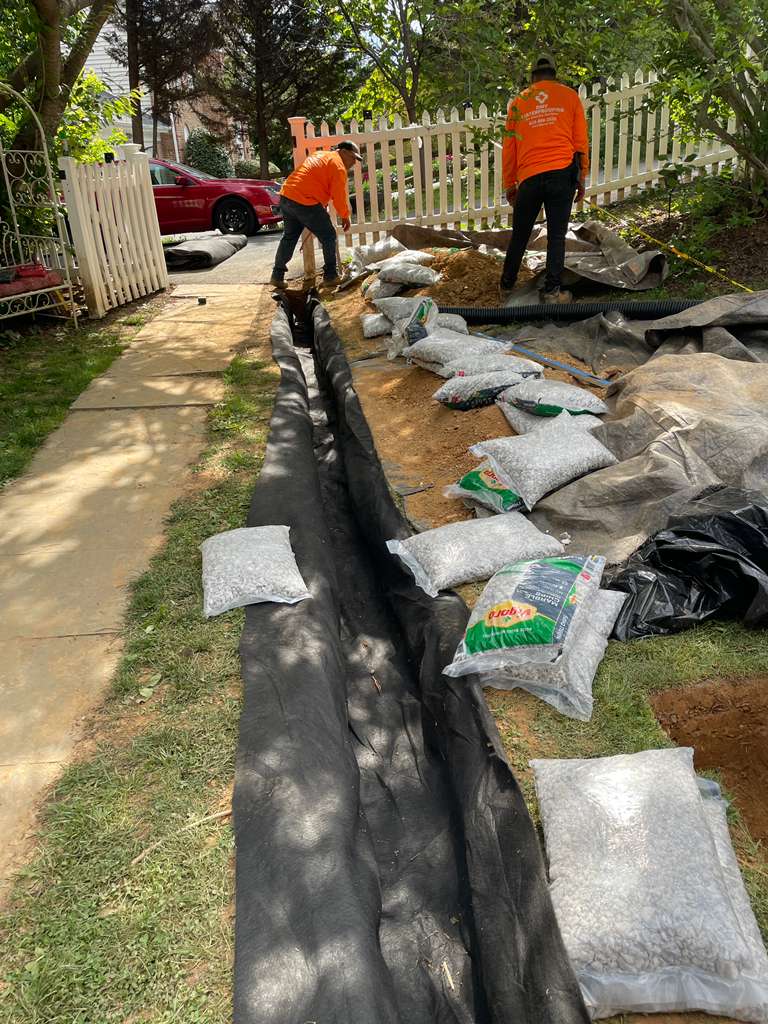
Our own crew, staging the stone. No subcontractors on this job.

Geotextile fabric lining the trench and wrapped up both sides — the step that keeps soil fines out of the stone.
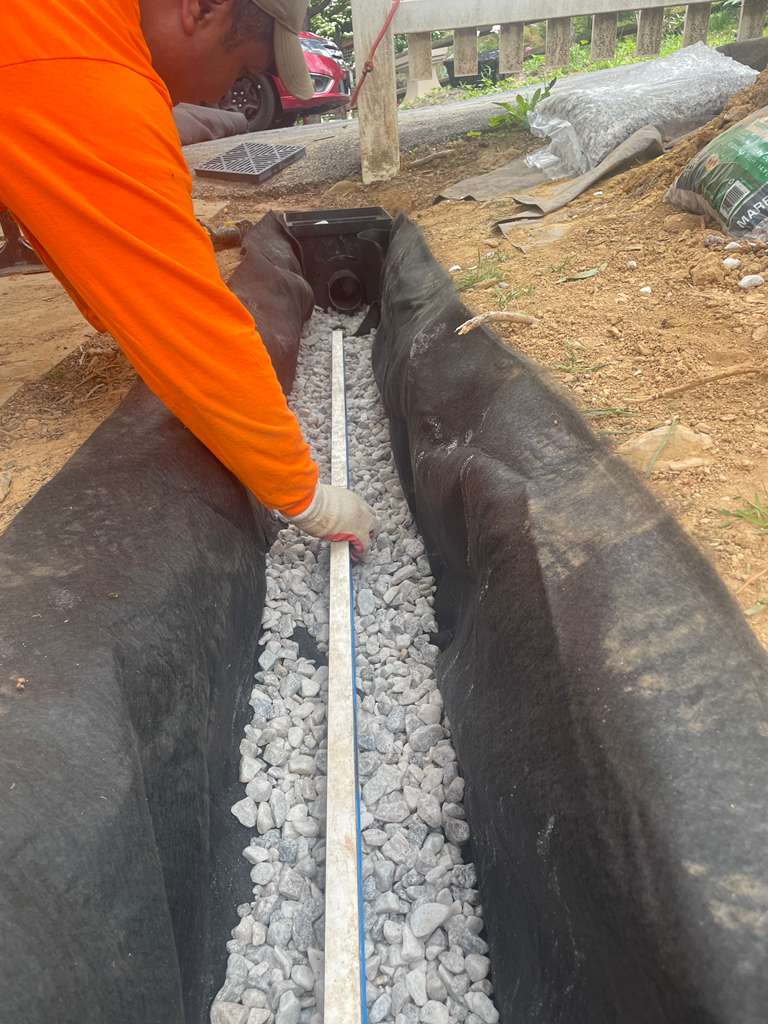
Checking the fall with a straightedge before a single length of pipe went in. Get this wrong and the drain becomes a holding tank.
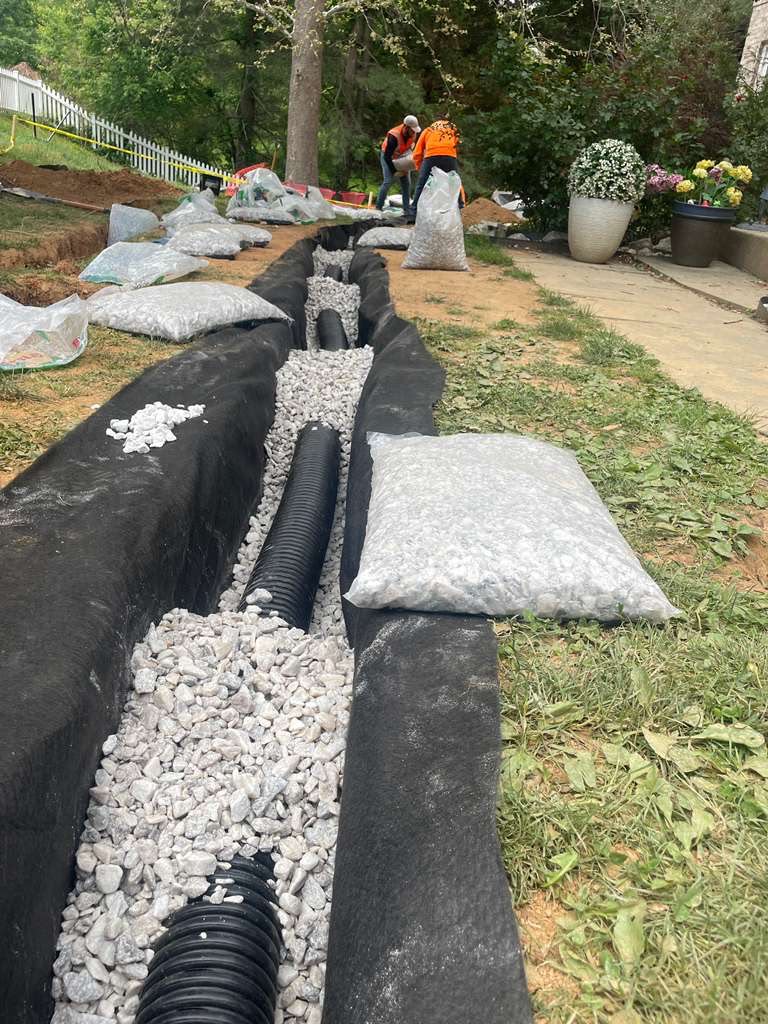
6″ perforated pipe on a bed of #57 washed stone, fabric open and ready to close over the top.

The catch basin on the line, taking surface water directly before it can spread across the yard.
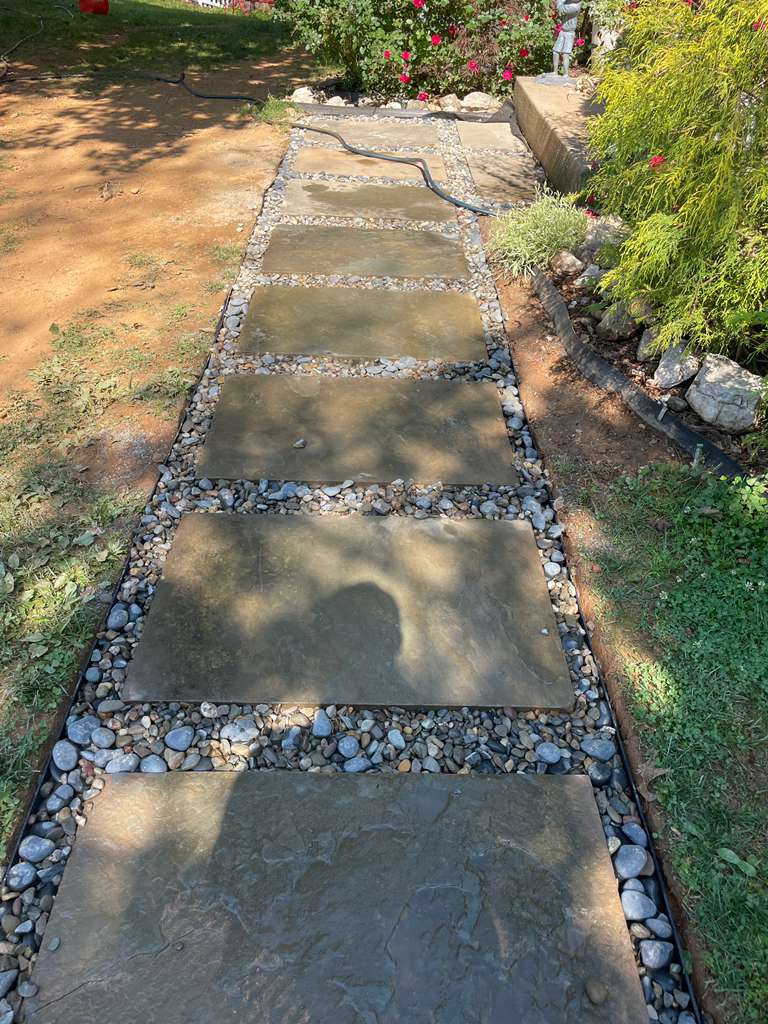
The flagstone walkway reset with its river-rock border once the line was closed up.
The result
The photograph we care about most is the one taken in the rain, after the work was done. The ground is wet, the walkway is wet — and no pond is visible in the photographed area. In the photographed area, no standing water is visible during that rain event. This is an on-site observation, not evidence of performance in every later storm or proof of the full underground flow path.
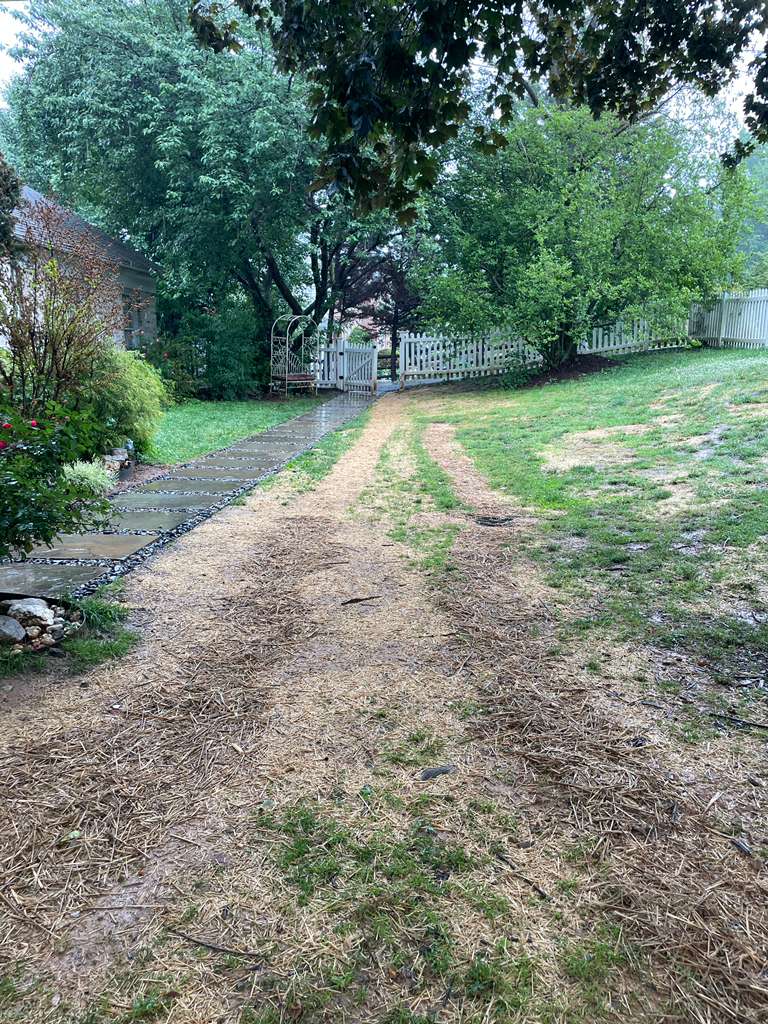
Taken in the rain after completion: straw down on the restored lawn, with no standing water visible in the photographed area.
The takeaway
When runoff collects in a low yard, the design needs a defined path and a suitable outlet. This case illustrates a graded trench, stone, filter fabric, perforated pipe and a catch basin. Proper grade, discharge and maintenance matter more than a one-size-fits-all promise.
Is your yard holding water after every storm? Schedule a free inspection — we’ll read the grade, find where the water is actually coming from, and tell you honestly what it takes to move it. Learn more about our yard drainage work.
Questions homeowners ask
Why do some French drains stop working after a few years?
Poor outlet design, sediment buildup, an uneven grade or unsuitable materials can all reduce performance. The actual cause requires inspecting the system and its discharge.
Can’t I just regrade the yard instead?
Sometimes. Regrading works when a safe surface route and outlet are available. On a lot receiving runoff from higher ground, a catch basin or subsurface drain may be needed as well. A site survey determines which route is feasible.
Written by S. Altan Atasoy — civil engineer (University of the District of Columbia), a member of the American Society of Civil Engineers — in the field since 2005.