

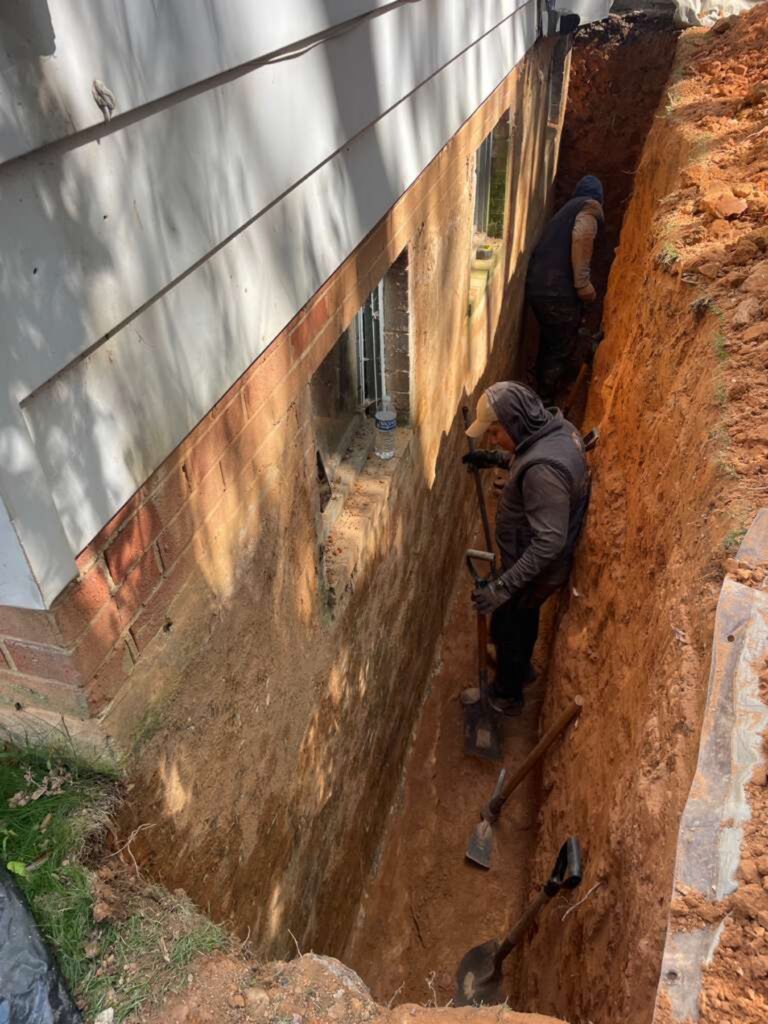
A crack, a damp basement wall, and a sticking door can look like one “foundation problem,” but they do not necessarily have the same cause. For homeowners in Maryland, Northern Virginia, and Washington, DC, the useful first question is not “Which product should I buy?” It is “What changed, where is water moving, and is the wall or footing moving?”
This guide explains the warning signs, the questions to ask during an inspection, and why a moisture repair is not automatically a structural repair. It is general information, not a diagnosis of a particular home.
Which foundation cracks need closer attention?
Document a crack’s location, direction, width, and whether it is changing. A wet crack in a poured-concrete wall may call for a different response than a stair-step crack in a block wall. A horizontal crack, visible inward bowing, displacement across a crack, or several new symptoms appearing together deserves prompt evaluation by a qualified professional. A photograph and a dated measurement are more useful than guessing from one image alone.
Do not cover a growing crack with a cosmetic finish and assume the cause has been solved. If a wall appears unstable, arrange a structural evaluation before planning waterproofing or finishing work.
Is the problem water, movement, or both?
Look at the timing. Does moisture appear only during heavy rain? Is water collecting beside the foundation or below a window well? Are gutters overflowing or downspouts emptying near the wall? Does the wall stay damp when it has not rained? Those observations help identify a water path. Doors that suddenly stick, floors that slope, and cracks that widen may point to movement requiring a separate assessment.
Water management matters even when the visible symptom is indoors. The U.S. Department of Energy advises directing roof runoff and surface drainage away from a foundation because saturated soil can drive moisture problems. That does not mean every wet basement needs a deep footing drain. The drain location and repair method must match the actual water path and the job scope. Read more about roof runoff and foundations and common basement water-entry paths.
What should a foundation inspection check?
- The symptom: crack pattern, leakage, wall alignment, floor condition, and when the issue appeared.
- The outside: grading, gutters, downspout discharge, hardscape, window wells, and any water pooling beside the house.
- The construction: poured concrete, block, stone, slab, or crawl-space foundation and the accessible wall and floor joints.
- The change over time: past repairs, dated photos, and whether cracks or doors are moving.
- The limits of the inspection: what could not be seen and whether a structural engineer or other specialist should assess it.
A useful proposal should say what was observed, what cause is suspected, what work is included, where collected water will discharge, and what is not covered. If the evidence does not establish a cause, further evaluation is better than a confident but unsupported repair prescription.
Which repairs might fit the findings?
Localized water entering a stable poured-concrete crack: a crack repair may address that opening, but nearby grading and roof runoff still deserve review. Our Rockville crack-repair guide explains the questions behind that decision.
Surface water directed toward a basement wall: the repair may start outside with downspout routing, grading, or an appropriately placed drain and safe discharge. We do not describe a grading drain tile as a footing drain; its position and purpose are different.
Water entering through a wider below-grade wall area: exterior excavation and waterproofing may be considered where access, condition, and the observed water path justify it. The wall preparation, crack and cold-joint repairs, waterproofing layers, protection, backfill, and final grading all matter. An interior collection system may be appropriate for some sites, but it is not an automatic substitute for correcting an exterior source.
Confirmed wall or footing movement: a structural repair needs a case-specific design and assessment. Sealing a crack alone does not correct active movement. We would not select reinforcement or underpinning from a blog checklist.
How much does foundation repair cost?
There is no responsible single price for “foundation repair.” Cost depends on the cause, wall type, access, depth, repair length, drainage route, and whether structural evaluation is needed. Ask for an itemized written scope and compare the diagnosis and discharge plan—not just the total. Our Maryland waterproofing cost guide discusses related budget factors; it is not a quote for structural work.
Frequently asked questions
Does every foundation crack mean structural failure?
No. Crack shape and movement, displacement, wall condition, and other symptoms matter. An actively changing or displaced crack deserves professional evaluation.
Will waterproofing repair a bowing wall?
Waterproofing addresses a water path; it does not by itself establish that a moving wall is structurally sound. A bowing wall needs its own assessment.
Do I need an interior French drain or sump pump for a wet basement?
Not automatically. First identify whether the water can be intercepted and discharged safely outside. Interior drainage and pumping may be appropriate in some conditions, but the recommendation should explain why that route fits the site.
Can I tell the right repair from a photo?
Photos can reveal crack patterns, standing water, or drainage details. They cannot show everything behind a finished wall or establish whether movement is ongoing. Use them alongside an on-site inspection and the written scope.
Get a diagnosis before choosing a system
DMV Waterproofing is engineer-founded and uses in-house crews. If you are seeing cracks, wall moisture, or water collecting near a foundation in the DC, Maryland, or Northern Virginia area, contact us for an inspection. Tell us when the symptom appears and bring any dated photos or prior repair records. We will discuss the observed water path and the next appropriate step without treating every house as the same job.