

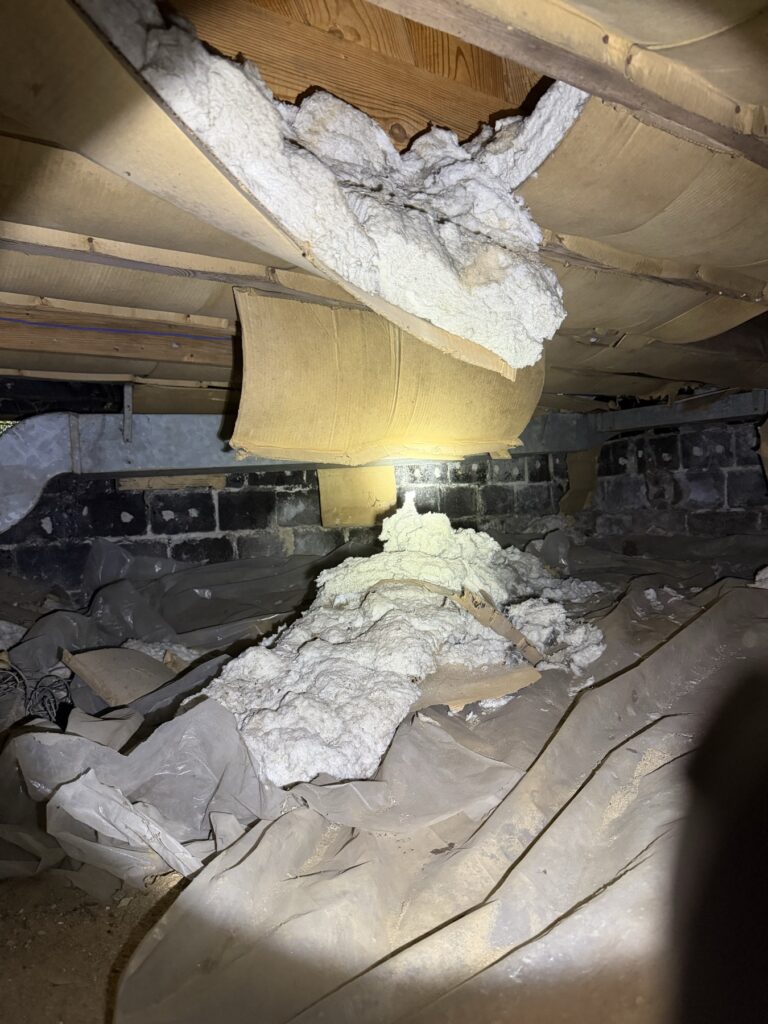
Musty odor above a crawl space, fallen insulation, visible moisture, and a soft floor are reasons to investigate, not diagnoses by themselves. A repair should begin by separating liquid water, ground vapor, humid air, plumbing or HVAC leaks, and structural movement. Some homes need one correction; others need a coordinated scope. This guide explains the questions to ask before choosing crawl space repair in DC, Maryland, or Northern Virginia.
Field photo: sagging fiberglass in a separate crawl space. It illustrates a condition to inspect, not the diagnosis or result for every property.
What signs should a homeowner document?
- Water: Note standing water, wet soil, wall staining, or drips, and record whether they follow rain or equipment use.
- Air and surfaces: Record musty odor, condensation on ducts or pipes, humidity readings, and visibly wet insulation.
- Structure: Photograph sagging or uneven floors, deteriorated wood, displaced posts, and any change over time.
- Outside route: Check where downspouts, sump lines, grading, and neighboring runoff send water.
A smell upstairs does not prove the crawl space is the source. A soft floor does not by itself prove moisture caused it. If you suspect unsafe electrical conditions, unstable framing, or extensive contamination, avoid entering the space and seek qualified help.
Where might crawl-space moisture come from?
Roof and surface water can collect at the foundation or flow through an opening. Exposed soil can release vapor. Outdoor air may condense on a cooler surface. Plumbing and HVAC equipment can leak or discharge into the space. Several routes may coexist. The soil, slope, foundation type, vents, and access differ from property to property; a county name or regional clay map is not a site diagnosis. Our DMV soil and water-table guide explains that distinction.
Which crawl-space repairs address which conditions?
Liquid water entering or standing on the floor
Trace the outside source and the entry point before adding equipment. Correcting a downspout, grading problem, or opening may be more direct than collecting the water after it enters. If a drain and sump are needed, the plan should show collection elevation, basin location, pump power and backup if specified, and a safe discharge route. A shallow surface or grading drain is not automatically a footing-level drain. A pump without a way for the relevant water to reach it will not solve a distant wet area.
Ground vapor through exposed soil
A properly detailed ground vapor barrier may be appropriate. The written scope should address material, seams, perimeter termination, penetrations, access hatch, and what happens at piers or uneven ground. A liner does not replace the need to correct active water entry. Encapsulation may include additional wall, air, and humidity details when those are needed.
Humid air or condensation
Check outdoor-air pathways, HVAC operation, duct condition, and humidity before specifying dehumidification or air sealing. A dehumidifier has to be sized, powered, maintained, and drained to a suitable endpoint. It can manage air moisture but cannot stop an active leak. Vent treatment and insulation placement should fit the actual design, not a universal checklist.
Wet insulation or damaged framing
Wet, loose, or contaminated insulation may need removal so the framing can be inspected and the moisture source corrected. Soft or sagging floors call for a structural evaluation of joists, beams, posts, bearing points, and any water damage. Reinforcement, replacement, or new supports should follow that assessment; vapor barrier alone cannot restore lost strength. Our crawl-space waterproofing guide explains how liquid water and vapor control serve different purposes.
Does every crawl space need a sump, liner, dehumidifier, and new supports?
No. Those components serve different purposes. A dry space with an exposed-soil vapor issue may not need a sump. A space with a localized exterior runoff problem may first need an outside drainage correction. A high humidity reading does not prove a structural failure, and sagging floors do not automatically require encapsulation. Ask the contractor to connect each proposed component to an observed condition and to identify the outlet or maintenance requirement for each system.
How long will crawl-space repair take, and what determines cost?
There is no responsible fixed duration or price without a measured scope. Size, safe access, debris removal, water source, utilities, drainage and discharge, electrical work, insulation, structural repairs, and restoration all affect the plan. Ask for an itemized written proposal that separates necessary work from optional upgrades and explains how completion will be checked. Financing or warranty terms should be verified in the actual agreement, not assumed from a general article.
Questions DMV homeowners ask
Will encapsulation remove a musty odor?
It may help when the odor source is moisture from the crawl space and that source is corrected. Odor can also come from other areas or materials. Identify the source before promising a result.
Should mold be cleaned before the moisture problem is fixed?
Cleaning without controlling the moisture source can allow a problem to recur. The approach depends on the material, extent, and safety conditions. The EPA mold guidance emphasizes moisture control.
Will a vapor barrier fix a bouncy floor?
No. A barrier limits soil vapor but does not repair framing or bearing conditions. A floor that is soft, uneven, or moving deserves its own structural assessment.
How can the finished work be checked?
Ask for photos of concealed details, a clear discharge route, operating checks for any pump or dehumidifier, and documentation of structural work. Then monitor the conditions that prompted the repair, especially after rain.
Request a crawl-space inspection
DMV Waterproofing is engineer-founded and serves homes across Washington, DC, Maryland, and Northern Virginia. We start with the observed water, air, and structural conditions before recommending a scope. Request an inspection or call 1-833-888-2533.