

How to Choose a Crawl Space Repair Company in DMV – An Engineer’s Field Guide
If you’ve started searching for crawl space repair companies in the DMV, you’ve probably already noticed something: every single website looks identical. Same stock photos, same “lifetime warranty” badges, same vague promises. Picking the right one is hard precisely because the marketing makes them all look the same.
We’ve been an engineer-founded crawl space and waterproofing company in the DMV since 2005. We’ve also been on the other side – re-doing failed jobs that other crawl space repair companies installed two or three years earlier. Patterns emerge. There are real differences between companies, and they show up in specific places if you know where to look.
This guide walks through what we’d want a homeowner to ask if they were vetting a crawl space contractor – including us. The goal isn’t to sell you on DMV Waterproofing. The goal is to help you avoid an expensive mistake.
Key Takeaways
- DMV crawl spaces fail in specific ways tied to clay soil, humidity, and water table – not generic “moisture.”
- The biggest red flag is a company that uses subcontractors instead of in-house crews.
- “Lifetime warranty” only matters if the warranty document spells out what’s covered and for whom.
- High-pressure same-day signing is a sales tactic, not a sign of urgency.
- The 7 questions in this guide separate legitimate crawl space repair companies from sales operations.
- A real DMV inspection takes time, includes measurements, and produces a written scope.
Why DMV Crawl Spaces Are Different
Before evaluating any company, understand what you’re actually fixing. The DMV’s geography creates crawl space problems that don’t exist in other markets.
Piedmont clay soil. Across most of Montgomery, Loudoun, and Fairfax counties, the soil is dense clay that holds water for days after rain. That moisture sits against your foundation walls and migrates through concrete pores into the crawl space. Our DMV soil and water table breakdown covers this in detail.
High summer humidity. Outdoor dew points exceed 70°F from June through September. Warm humid air enters through crawl space vents and condenses on every cool surface – joists, ducts, insulation. This is why ventilated crawl spaces in the DMV often fail; the conditions invert the design assumption.
Variable water table. In sections of Rockville, Bethesda, Ashburn, and Manassas, the water table sits high enough that hydrostatic pressure pushes moisture upward through the crawl space floor. Our post on underground water in DMV basements explains the mechanism. For broader principles, see the EPA moisture control guidance.
A company that doesn’t reference any of this – who treats your DMV crawl space like a generic problem – probably isn’t engineering a DMV-specific fix.
What Legitimate Crawl Space Repair Companies Actually Do
A real crawl space scope of work covers six categories. If a quote skips any of these, ask why.
1. Moisture source identification. Where is the water coming from? Surface runoff, vapor diffusion, hydrostatic pressure, plumbing leak, or condensation? Each has a different fix. A company that quotes a solution before answering this is selling a product, not solving a problem.
2. Bulk water management. For active water intrusion: interior drainage, sump pump installation, exterior grading, or french drains. Required only when there’s an actual water source.
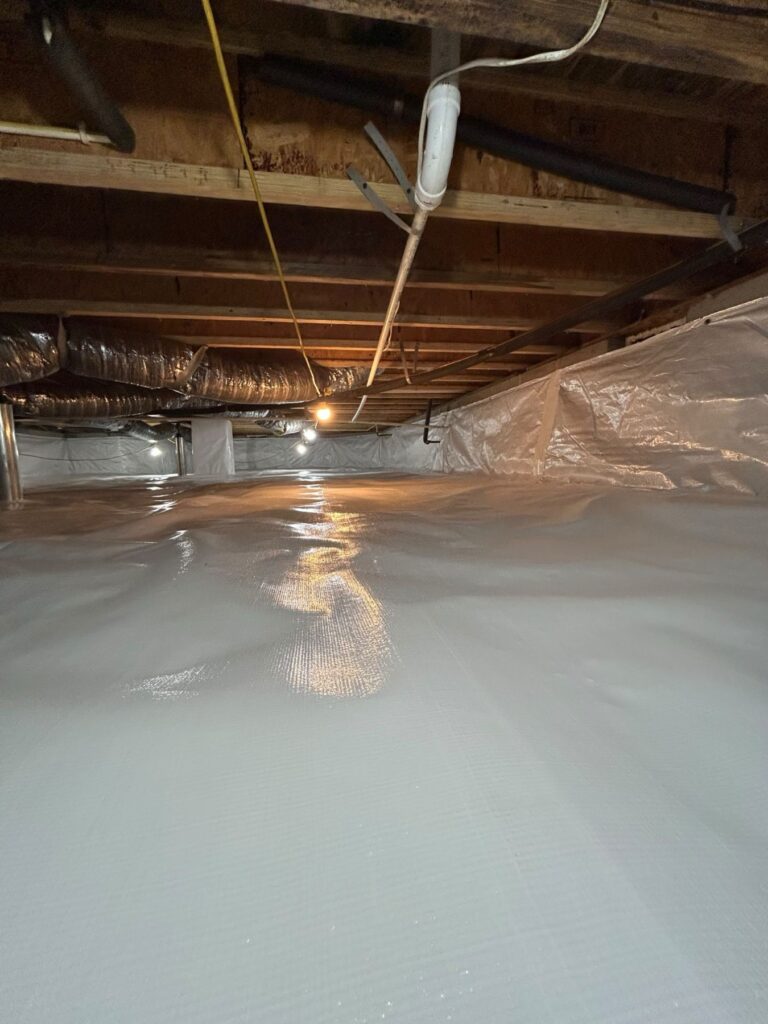
3. Vapor barrier and encapsulation. A sealed liner on floor and walls to block soil vapor. Materials matter – 6-mil construction plastic is not the same as a 12-20 mil reinforced encapsulation membrane. Our crawl space encapsulation guide explains the seven-step process and what each step actually does.
4. Humidity control. A dedicated dehumidifier sized for the cubic footage. Without this, even a perfect encapsulation can develop moisture in the DMV climate.
5. Structural repairs. Sagging joists, rotted sills, failed support posts, or settled piers. These often only become visible after cleanup and require an engineer’s call on what’s structural versus cosmetic.
6. Insulation and air sealing. After moisture is controlled, closed-cell foam or rigid board insulation maintains the conditioned envelope.
If a company’s scope only includes items 3 and 4 – encapsulation and dehumidifier – they may be missing the actual problem.
For industry technical standards, the International Concrete Repair Institute maintains foundation and concrete repair guidelines.
Red Flag #1 – Subcontractors Instead of In-House Crews
This is the single most common reason crawl space jobs fail. The company you sign with isn’t the company that shows up.
When a company subs out the install:
- The crew has no accountability to the warranty.
- Quality varies wildly between subs – there’s no consistent training.
- If something fails, the company points at the sub; the sub is no longer reachable.
- The crew is paid per job, not per hour, so corner-cutting is rewarded.
Ask directly: “Are the crews installing my system W-2 employees of your company, or are they subcontracted?” A legitimate company will answer plainly. An evasive answer (“we work with trusted partners”) usually means subs.
DMV Waterproofing has used in-house crews exclusively since 2005. No exceptions, no peak-season subs.
Red Flag #2 – “Lifetime Warranty” Without Paperwork
“Lifetime warranty” is the most abused phrase in this industry. It’s meaningful only when the document defines:
- What is warrantied (membrane? labor? sump pump? structural fix?)
- For how long (lifetime of the structure? of the homeowner? of the membrane?)
- What voids it (ownership transfer? maintenance gaps? unrelated repairs?)
- Who pays for materials versus labor on a warranty claim?
- What’s the claim process – written notice, inspection, response time?
If a salesperson says “lifetime warranty” but can’t hand you the warranty document on the spot, you don’t have one. We’ve seen warranty disputes where the customer kept a glossy brochure and the company’s actual warranty terms were ten lines on a separate sheet, signed years earlier, with twenty exclusions.
Ask: “Can I see the actual warranty document before I sign anything?” Read it. If the salesperson resists, that’s your answer.
Red Flag #3 – Same-Day Signing Pressure
The pitch goes like this: “If you sign today, we can lock in this price / get you on the schedule next week / honor this discount.” It’s a sales tactic from the high-pressure home improvement playbook. Real crawl space problems don’t get worse in 48 hours.
Legitimate crawl space repair companies will:
- Provide a written estimate that’s valid for 30+ days.
- Encourage you to get a second opinion.
- Not call you repeatedly the day after the inspection.
If a company’s pricing depends on signing tonight, the price isn’t real – it’s an opening bid in a negotiation, and you’re being timed out before you can think.
The 7 Questions to Ask Before You Sign
These are the questions we’d want a DMV homeowner to ask any crawl space contractor – including us.
1. What specifically do you think is causing the moisture in my crawl space? A real answer references inspection findings, not a generic list. If they describe your specific situation back to you, they paid attention.
2. Are your installation crews W-2 employees of your company? Yes or no. No “trusted partner” deflection.
3. Can I see the actual warranty document and an example of a past claim? Real companies have processed warranty claims and can describe the process.
4. How long has your company operated under this name in this state? Some operators rebrand every few years to escape past warranty obligations or BBB complaints.
5. What’s the brand and model of the dehumidifier and the membrane you’d install? Vague answers (“commercial-grade,” “industry-leading”) suggest the spec changes based on margin. Real companies will tell you the manufacturer.
6. Will you provide a written scope of work before I sign? Not a price – a scope. What you’re getting, line by line. If everything is bundled into one number, you can’t compare quotes or hold them to anything.
7. Can I have references for two jobs done in my zip code in the last 12 months? Local jobs, recent. Old testimonials on a website prove nothing.
A company that answers all seven plainly is doing things right. A company that flinches on three or more is selling, not solving.
What a Real DMV Crawl Space Inspection Looks Like
A serious inspection takes 45–90 minutes minimum. Here’s what should happen:
- The inspector enters the crawl space – not just looks through the access door.
- Moisture readings on multiple surfaces (joists, sills, floor, walls).
- Humidity and temperature readings logged.
- Photos of every problem area, with location notes.
- Identification of structural concerns: sagging, rot, settlement, prior repairs.
- Discussion of likely sources before any solution is proposed.
- A written scope and price provided either on-site or within a few days.
A 15-minute walk-through ending in a same-day quote is a sales call, not an inspection.
What We Do at DMV Waterproofing
We’re an engineer-founded company. The two founders worked as ECS Limited field inspectors before starting DMV Waterproofing in 2005 – which means we approach a crawl space the way structural engineers do, not the way a sales-driven national franchise does.
Three local branches, in-house crews only, no subcontractors ever. Free inspections across DC, Maryland, and Virginia. Lifetime structural warranty on waterproofing systems, with the warranty document available before you sign – not after.
If you’ve already gotten quotes from other crawl space repair companies and want a second opinion, we’ll do the inspection and tell you honestly what we’d do differently, even if it’s nothing.
Call 1-833 888 2533 or email info@dmvwp.com for a free DMV inspection.
FAQ
How much do crawl space repair companies typically charge in DMV?
A typical DMV crawl space encapsulation runs $5,000–$15,000 depending on square footage, moisture severity, and whether structural repairs are needed. Bulk water problems requiring drainage and sump add to that. Beware quotes significantly below this range – corners are being cut somewhere.
How long does crawl space repair take in a DMV home?
Most encapsulation projects take 2–4 days for an in-house crew. Add 1–2 days for structural repairs or interior drainage. A company quoting “one day” for a full encapsulation is either skipping steps or rushing the work.
Do crawl space repair companies offer financing?
Reputable ones do. Look for 0% APR options through providers like Wisetack – those are real promotional rates with no fees. Be cautious of in-house financing with vague terms; the rates and fees can be substantial.
What’s the difference between encapsulation and waterproofing?
Encapsulation is a sealed vapor barrier on floor and walls plus a dehumidifier – it controls moisture from soil and air. Waterproofing addresses bulk water intrusion with drainage and pumps. Most DMV crawl spaces benefit from both, depending on the moisture source.
Should I get multiple quotes from crawl space repair companies?
Yes. Get at least three written scopes. Compare not just price but what’s actually included – membrane thickness, dehumidifier brand, drainage details. Identical-looking quotes often vary by thousands of dollars in actual scope.
How do I verify a crawl space repair company is licensed and insured?
Maryland MHIC license, Virginia Class A or B contractor license, DC general contractor license. Each state has an online lookup. Ask for current insurance certificates and verify directly with the carrier – not just from a copy the company hands you.


