

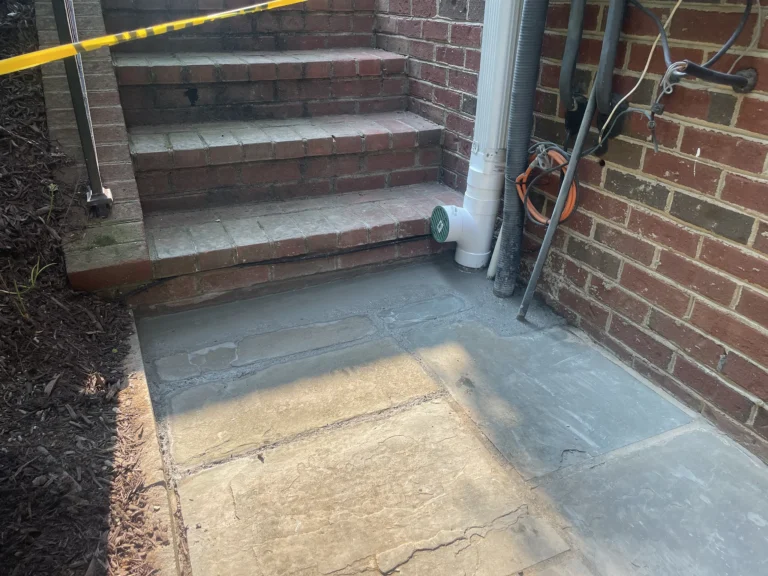
At a Potomac, Maryland home, an exterior channel drain crossed the concrete entry landing beside brick steps. A downspout and an existing discharge route occupied the same tight area. The documented project had a specific goal: remove the old surface channel, carry water through a buried solid pipe, and restore the landing with a flush concrete cap. This was a targeted entryway drainage conversion, documented from the opened landing to the finished concrete surface.
The site constraint: a drain across the walking surface
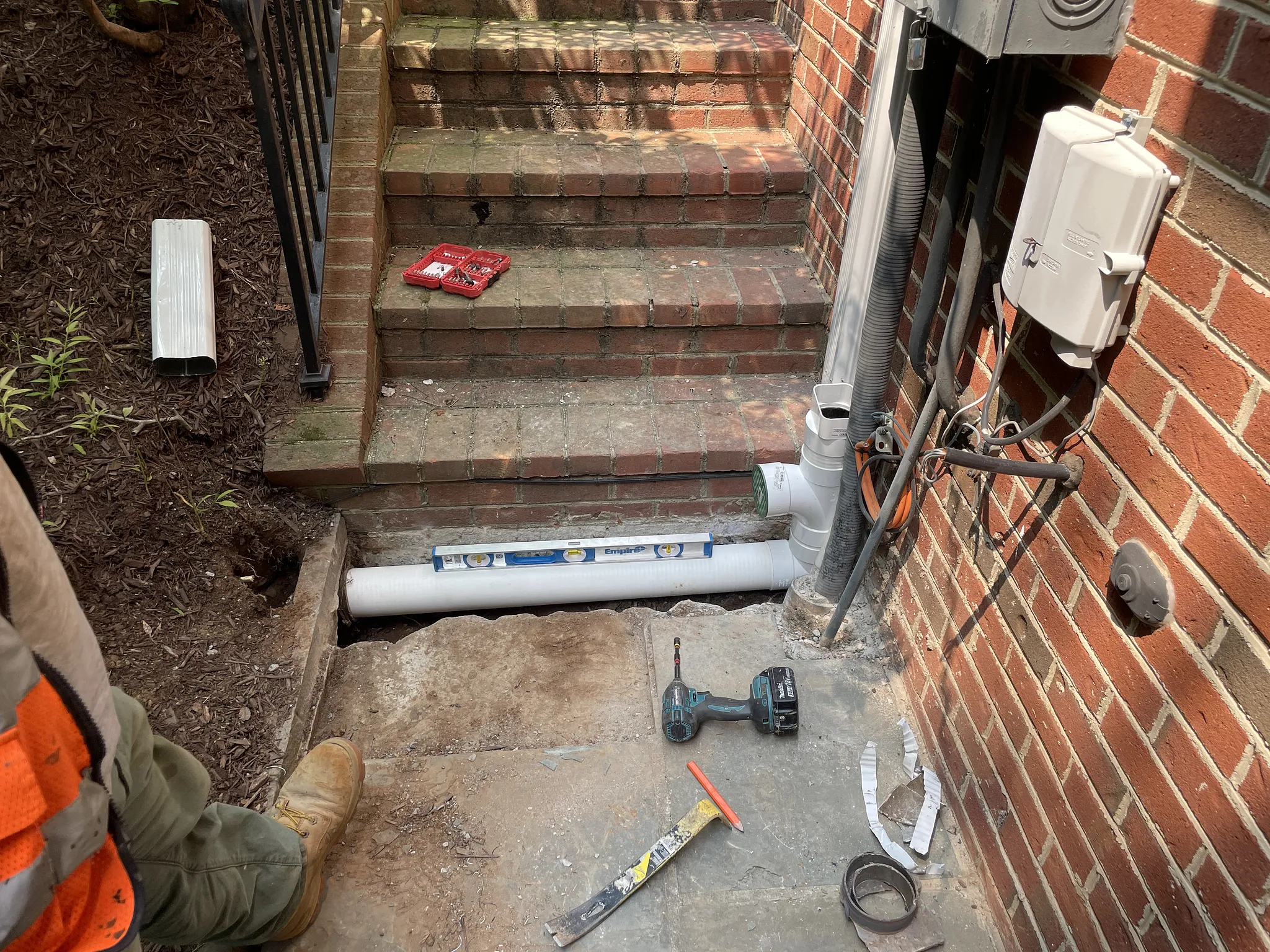
The old channel occupied a narrow strip of concrete near the steps. The work had to establish a below-surface route while leaving the entry usable again. The approved scope specified removing the channel drain, installing a 4-inch solid PVC pipe in its place, and tying that pipe into the existing discharge line. The crew’s construction photo shows the white PVC set in the opened strip, with a fitting near the downspout.
Why solid PVC was the right pipe for this scope
This section was designed to convey water through a defined route to an existing discharge line. Solid pipe performs that transport role without admitting surrounding soil water along its length. A perforated pipe in a stone-filled trench is a collection system; it would solve a different water-path problem. The detailed scope and job photos identify this work as a channel-drain conversion with solid pipe, not a perforated French drain.
Concrete repair and surface slope
After placing the pipe, the crew backfilled the opening and poured a concrete cap flush with the surrounding landing. The finished photo shows the work strip closed beside the steps. The scope called for a slight pitch toward the yard so surface water sheds across the new concrete rather than sitting on the patch. The pipe below the slab and the grade of the concrete above it have different jobs; both matter to the finished drainage detail.
The project is recorded as completed, and the before-the-cap and finished photographs document the conversion. The available record does not include a later rain test, so the photographs establish the finished construction rather than a measured post-storm result.
Questions homeowners ask about channel-drain replacement
Can an exterior channel drain be replaced with a buried pipe?
Sometimes. This Potomac entryway had a defined existing discharge connection, and its approved scope called for 4-inch solid PVC under a repaired concrete surface. At another property, the inlet, outlet, elevations, access, and expected flow must be checked before choosing that approach.
Why not use perforated French-drain pipe?
Perforated drain tile collects water from a gravel bed. Here, the documented task was moving water through the landing into an existing discharge line, so the installed pipe was solid. Calling every buried drain a “French drain” can hide this important distinction.
Does the concrete still need to slope if a drain pipe runs below it?
Yes. The replacement cap was specified to have a slight pitch toward the yard. Surface slope directs water on top of the concrete; the pipe handles water inside its own route. One does not replace the other.
Where does the buried solid pipe discharge?
For this job, the approved scope connected the new pipe to an existing discharge line. The photos do not establish that line’s final outlet. On any similar project, the discharge location and elevations should be confirmed before replacing a surface channel.
Have an entry channel drain, downspout, or concrete landing that sends water the wrong way? Request a site assessment. We first trace where water enters, how it leaves, and whether a surface drain, solid conveyance pipe, or a different drainage system fits the actual condition.