

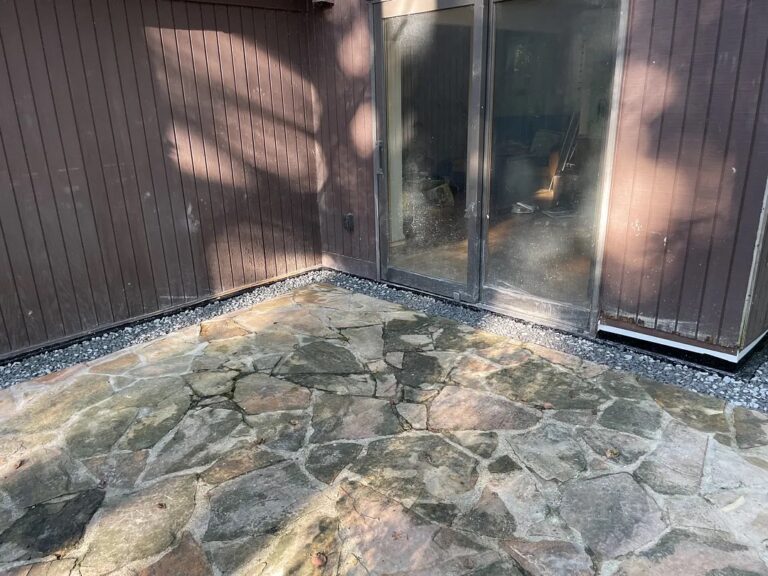
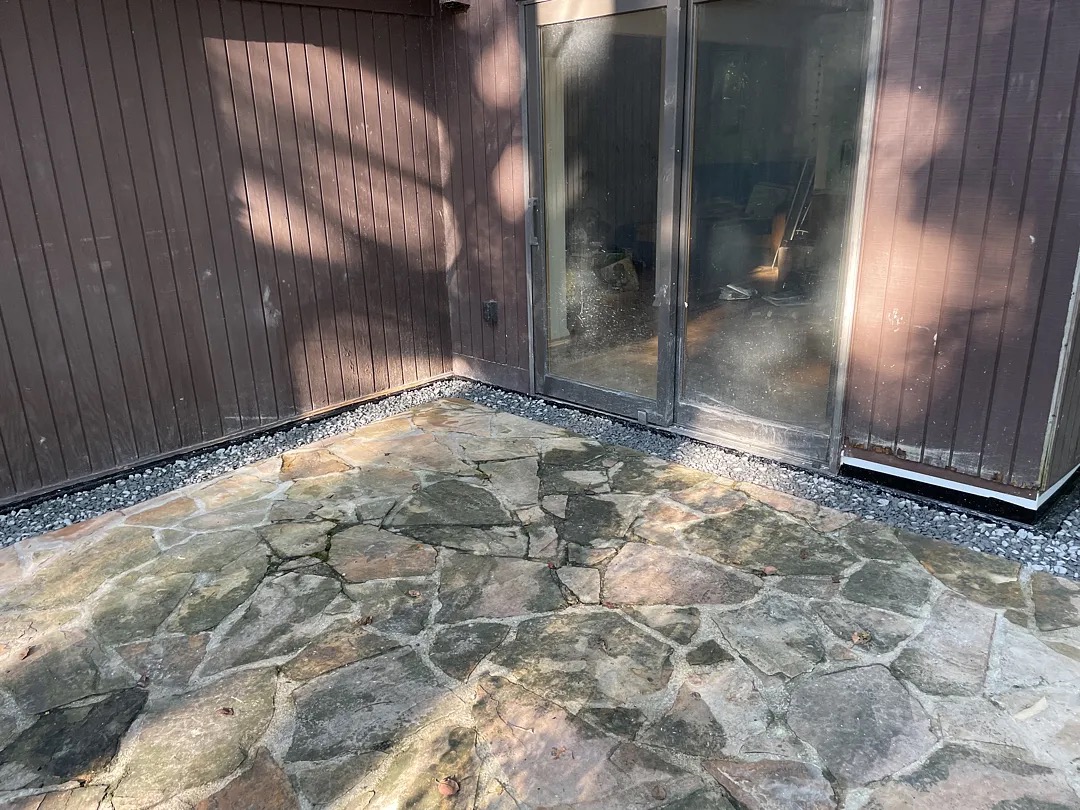
Water was still entering a basement extension in Potomac, Maryland, and the homeowner reported deterioration around its windows and sliding door. Outside, a glass wall met a broad stone patio with very little room for drainage work. This completed project placed an exterior French drain along that narrow edge to intercept water before it collected beside the extension.
What made this basement leak difficult?
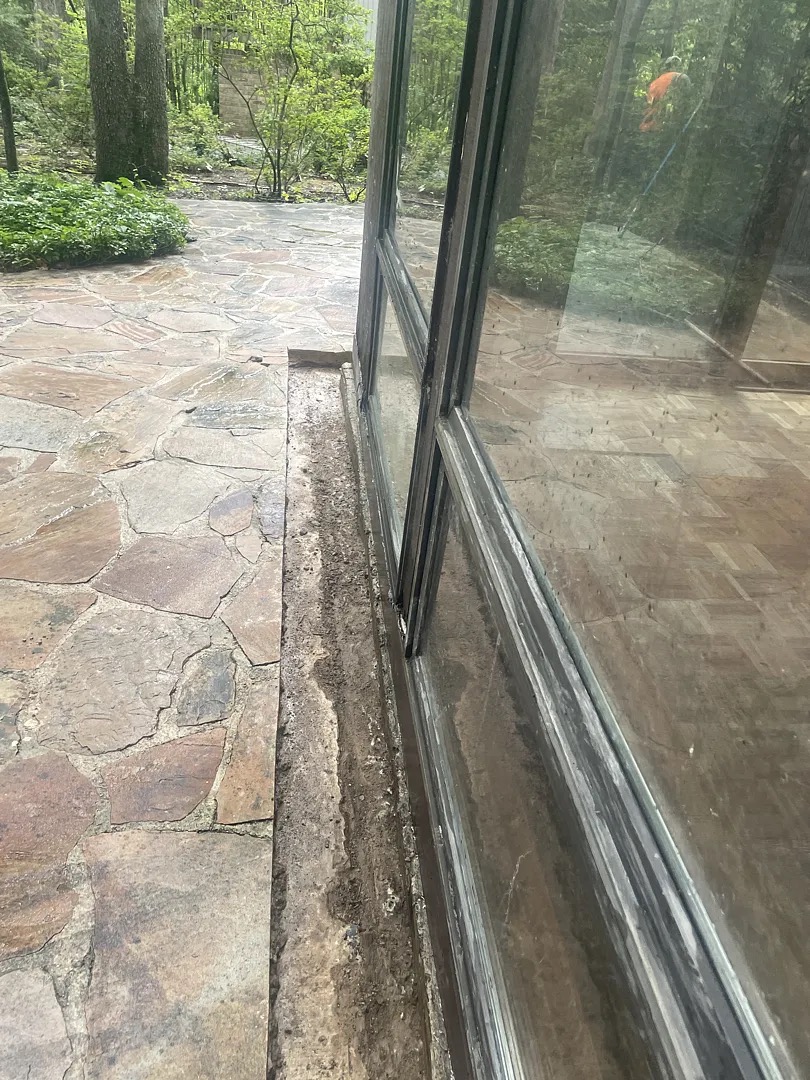
The customer’s first request described continuing water entry and damage around the windows and sliding door. The photos show the tight exterior setting, but they do not identify a single leaking crack or prove that every deteriorated frame had the same cause. The challenge was to collect water along this exposed edge without tearing out the entire patio.
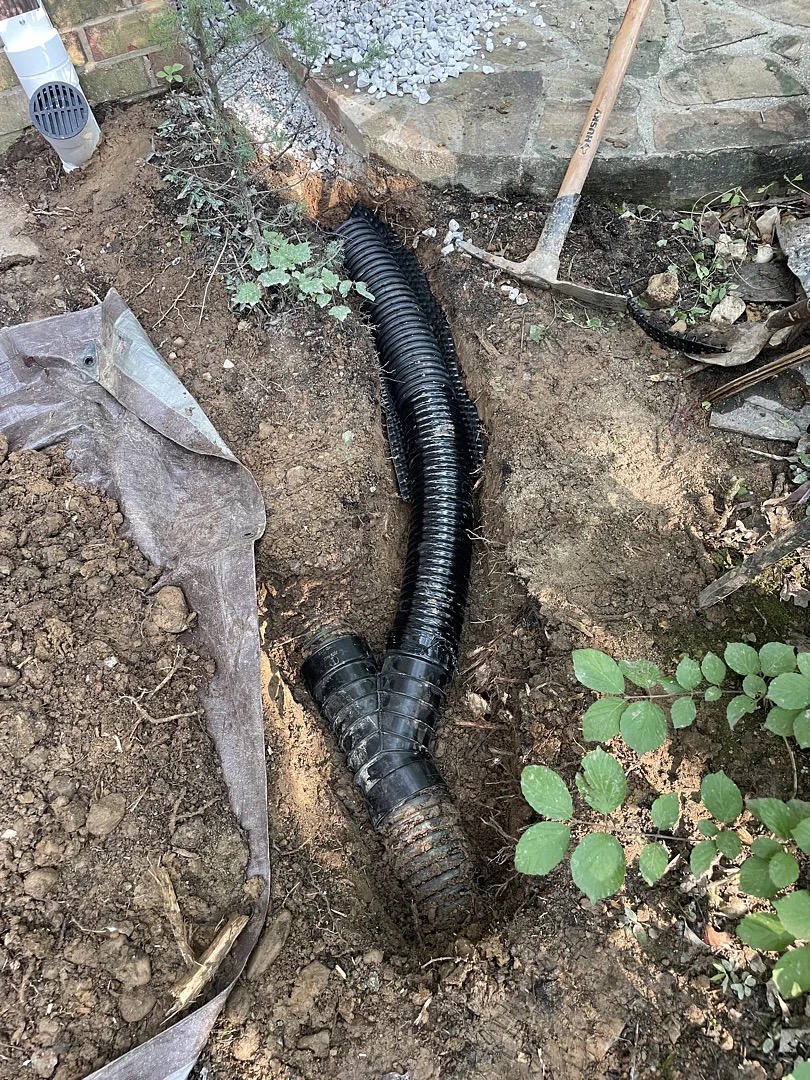
The completed scope called for roughly 50 linear feet of near-grade trench, about 12 to 18 inches wide and deep. The strip between the extension and trench was raised and shaped to send surface water toward the collection line. The trench bottom was compacted and given a continuous fall toward its discharge route. Both slopes matter: the surface must bring water to the trench, and the trench must carry it away.
How the exterior French drain was built
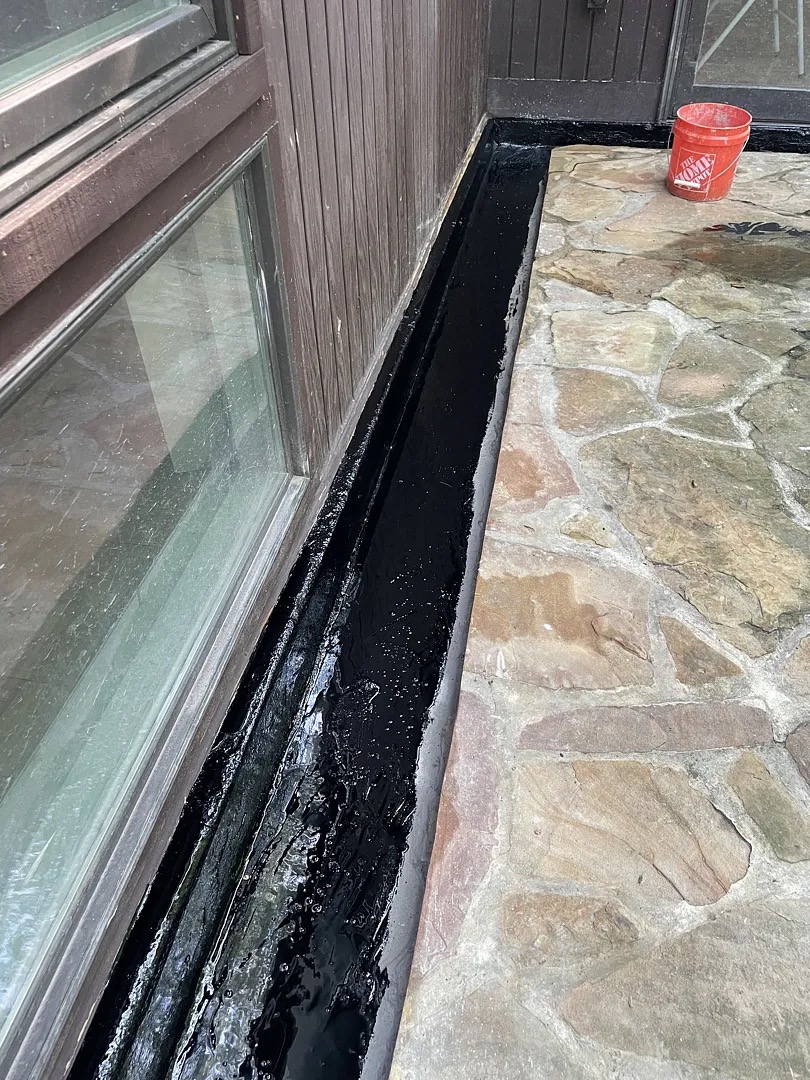
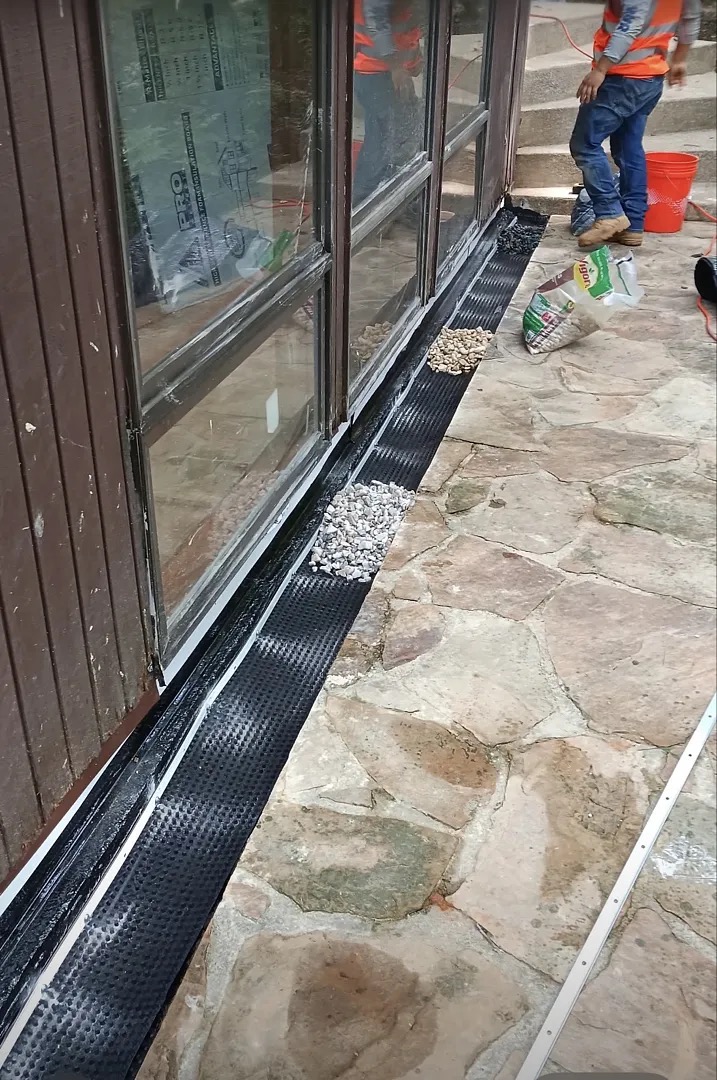
A waterproof membrane lined the trench to limit water soaking back into the ground beside the extension. The crew installed a four-inch perforated pipe wrapped in nonwoven geotextile and surrounded it with washed gravel. Stone lets approaching water enter; fabric helps keep soil fines from migrating into the collection zone. This line sits near the level of the approaching surface water, alongside the patio.
Keeping roof water on its own route
The job also included buried downspout work, a solid discharge-pipe run, a pop-up emitter, and a dry-well item. The perforated trench pipe collects water through gravel; solid pipe carries roof runoff or collected water toward an outlet without releasing it beside the house. These are different functions even when installed during the same project. The reviewed photos do not establish every underground connection, so the visible pipe work should not be mistaken for a complete as-built map.
What the completed work looks like
The photos show the open, lined trench giving way to a neat gravel band following the extension and stone paving. The patio remains the defining feature of the finished space. The job record marks the installation complete; it does not include a later storm test or homeowner report documenting interior conditions. The result shown here is the completed exterior water-control route, not an invented claim about a future storm.
Questions homeowners ask about exterior French drains
Can an exterior French drain help with water near basement windows or a sliding door?
It can intercept water approaching that exterior edge when located across the flow path and connected to a suitable outlet. A defective window or door assembly may also need its own repair; drainage is not a substitute for diagnosing that detail.
Why must the soil between the wall and drain be sloped?
Water reaches a collection trench only if the surface directs it there. Grading the strip away from the wall and toward the gravel line helps keep runoff from lingering against the glazing and wall base.
What is the difference between perforated and solid drainage pipe?
Perforated pipe receives water through a gravel-filled trench. Solid pipe conveys collected water or roof runoff away without releasing it along the route.
Can this work be done beside an existing stone patio?
It depends on access, grade, and the available outlet. On this project, the crew worked in a narrow band alongside the existing paving and finished with a gravel border.
Water entering a basement extension in Potomac? Request an inspection to trace the water path and assess the exterior grade, collection point, and discharge. Learn more about our exterior French drain work.