

Short answer: Buried downspouts and a pop-up emitter can be the right fix when roof runoff is saturating the soil beside your foundation. They are not a substitute for exterior waterproofing, a French drain, or an interior French drain when water is coming from a different path.
A completed Rockville job record lists two buried downspout runs and one pop-up emitter. It documents the roof-runoff work, but does not record a detailed initial basement complaint or a post-storm result.
Can buried downspouts fix a wet basement?
Sometimes. A roof can shed hundreds of gallons in an ordinary storm. When a downspout releases that water at the wall, in a planting bed against the house, or onto a splash block that drains back toward the foundation, it overloads the one area of soil you most need to keep dry.
If that is the source, downspout drainage may be an appropriate first correction. If the basement is wet away from every downspout, along an entire wall, through a crack, or at the wall-floor joint, roof water may not be the whole explanation. The solution must follow the water path.
How a buried downspout and pop-up emitter work
- The downspout connects to a solid buried pipe.
- The pipe is installed with fall away from the foundation.
- It carries roof runoff to a safe discharge area.
- A pop-up emitter sits flush with the lawn, opens when water flows, and closes after the rain so debris stays out and a mower can pass over it.
A buried downspout line carries roof water. A French drain generally collects water from the soil through perforated pipe. A property may need both, but the terms are not interchangeable—and treating them as the same system is how the wrong solution gets sold.
What did the Rockville job include?
The completed job scope lists two buried downspout lines and one pop-up emitter. The before-work assessment photo below shows one existing downspout and flexible surface extension beside the garage walkway. The record does not include same-job construction or completion photos, a measured pipe route, the exact outlet position, or a dated rain test. The photo does not establish the final buried layout or performance.
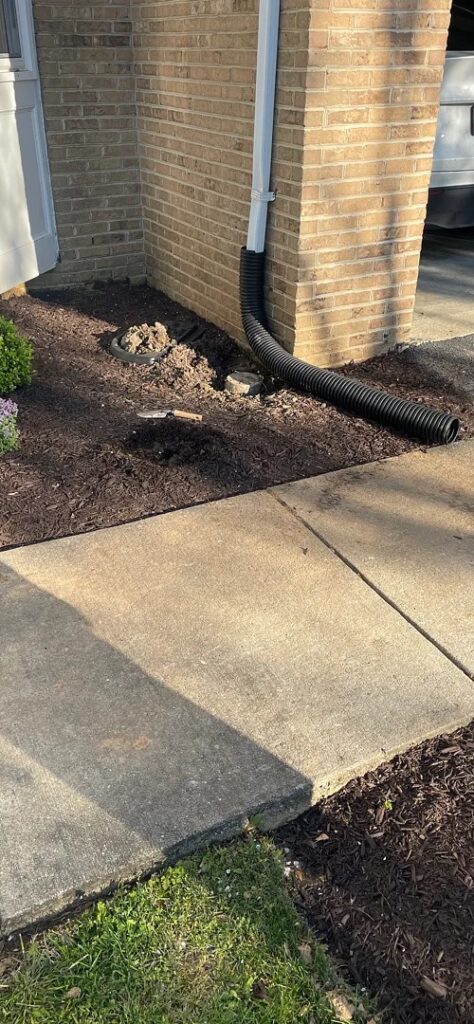
Length of run, depth, slope, outlet location, utility conflicts, access and restoration all affect a downspout drainage estimate. This case describes the work category, not a price for another property or proof that every basement-water problem here was solved.
Signs roof runoff may be part of your water problem
- Water pools near the foundation while it is raining.
- A downspout ends in a bed, on a short splash block, or at a low spot that drains back toward the house.
- The wet area inside is near the outside location where a downspout discharges.
- A buried line exists, but you cannot identify where it discharges or whether it is blocked.
- The problem becomes much worse during roof runoff, even in a storm that does not flood the rest of the yard.
The best homeowner test costs nothing: watch the property during a real storm, not after it. Follow each downspout from the gutter to its final discharge. A correlation is not proof, but it is valuable evidence for the inspection.
When a buried downspout is not enough
We do not recommend downspout drainage as a catch-all answer. A different water path calls for a different scope:
- Water through a localized foundation crack: the crack may need repair, often with the water source corrected too.
- Water against an accessible foundation wall: exterior waterproofing may be the right direct repair.
- Water at the wall-floor joint or persistent below-slab pressure: an interior French drain system may be appropriate.
- Water crossing or collecting in the yard: grading, a yard drain, or an exterior collection drain may be needed before water reaches the house.
For example, if the water table is low, there is no upward pressure from below the slab, and the outside foundation wall is accessible, exterior waterproofing can be the cleaner answer. Selling an interior drain in that situation just because it is a familiar product would not be engineering.
What to ask before installing downspout drainage
- Where will the line discharge, and will water stay away from the foundation?
- Does the route have enough fall, or will the system need another design?
- How will the outlet remain clear and serviceable?
- Are utilities, hardscape, or neighboring properties part of the route?
- What evidence shows roof runoff is the source of the basement or crawl-space moisture?
The right scope starts with the cause
The Rockville record confirms a completed scope for two buried downspouts and a pop-up emitter. It does not independently establish a basement-water diagnosis or long-term performance. If a basement is also wet, the actual entry path should be checked before treating downspout work as a complete waterproofing solution.
Have water pooling near your foundation or a wet basement after rain? Schedule a free inspection so we can determine whether the cause is roof runoff, surface drainage, a foundation-wall issue, or water below the slab.