

From Our Field Notes · Crawl Space Guide
Crawl Space Sealing: What It Fixes and When You Need More
A practical guide from an engineer-founded waterproofer with 20+ years of DMV field experience.
Crawl space sealing closes specific gaps that let outdoor air, pests, and moisture reach the space beneath a home. It can help with a musty smell, drafts, and visible openings—but it does not, by itself, stop an active water leak or replace a drainage plan. The right repair depends on where the moisture is coming from.
Based on our 20+ years of field experience across Maryland, Virginia, and DC, this guide answers six practical questions: what to inspect, when drainage is needed, what a vapor barrier does, how to close pest openings, whether to seal vents, and where insulation belongs.
What Is Crawl Space Sealing?
Crawl space sealing is the air- and gap-sealing part of a moisture-control plan. Depending on the house, that plan may also include:
- Liquid-water control – identify and correct foundation leaks, roof runoff, poor grading, or standing water before covering the symptoms.
- Drainage where needed – choose an exterior correction, a gravity outlet, or an interior drain and pump only when the site conditions call for it.
- Air control – seal appropriate openings and evaluate the venting and conditioning strategy for this specific crawl space.
- Pest-resistant details – close accessible gaps and penetrations with materials suited to their size and exposure.
- Insulation where appropriate – place it in an assembly that also manages moisture, air, and applicable code requirements.
This is why crawl space sealing is best understood as part of a broader crawl space encapsulation system. If liquid water is still entering, gap sealing alone will not solve the underlying problem.
Why DMV Homes Need Crawl Space Sealing
DMV crawl spaces face humid summers, seasonal temperature changes, and rainwater that can collect around a foundation. Soil and drainage conditions vary by property, so the first step is to trace the actual water path rather than assume every home has the same cause.
Common warning signs include:
- Damp soil, staining, or visible growth on framing
- Openings around vents, pipes, or the foundation that can admit pests
- Missing or wet insulation and noticeable floor drafts
- A musty odor that may be connected to moisture below the living area
The EPA recommends covering dirt in crawl spaces to reduce ground moisture. The U.S. Department of Energy explains that a continuous, sealed ground cover limits moisture moving from the soil into the space.
Six Questions That Shape a Crawl Space Sealing Plan
These are six decisions, not six mandatory line items. A dry crawl space with a few air leaks may need a much smaller scope than one with standing water.
Step 1: Inspection and Diagnosis
Before specifying materials, inspect for standing water, roof runoff, grading, foundation cracks, plumbing leaks, damaged ground cover, wet insulation, and openings around pipes and ducts. Document the source and route of water; a sealant cannot compensate for water still being directed toward the foundation.
Step 2: Drainage and Sump Pump (When Needed)
If water is entering, first ask whether it can be intercepted and carried away outside by correcting grading, downspouts, or drainage. Where site conditions do not allow a gravity solution or water enters from below, an interior drain and sump pump may be appropriate. A pump is not a standard part of every sealing job.
Step 3: Vapor Barrier Installation
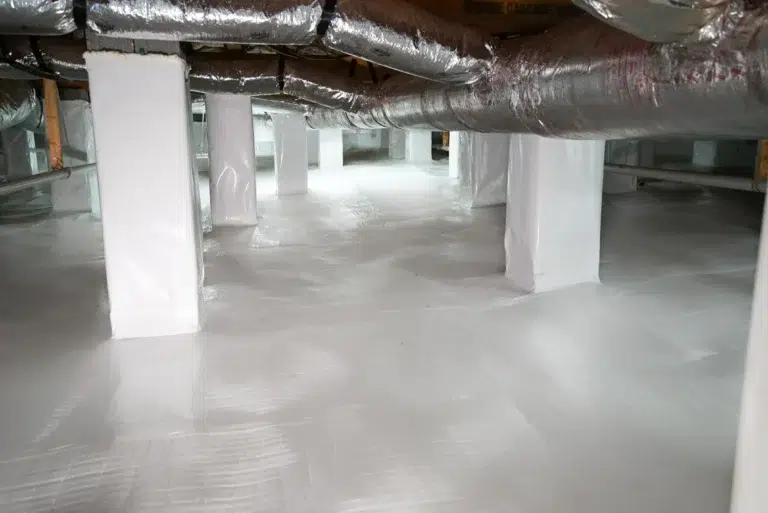
A ground vapor barrier limits moisture evaporating from exposed soil. Its material and thickness depend on the space and expected use; seams, piers, edges, and wall connections must be detailed as a continuous system. A barrier controls vapor—not a stream of liquid water or an unrepaired foundation leak.
Step 4: Closing Pest and Rodent Entry Points
This is where material selection matters most. Different gaps need different solutions:
- Animal entry holes: close with a durable, pest-resistant material suitable for the opening; foam alone may not resist rodents.
- Larger masonry gaps: repair with a compatible masonry method after checking whether movement or water pressure is involved.
- Pipe penetrations and small gaps: use a compatible sealant or approved assembly selected for the substrate and exposure.
The point is to match each repair to the opening. Check the work after installation and again if new pest activity or moisture appears; no single filler suits every gap.
Step 5: Sealing Vents
Should crawl space vents be sealed? Sometimes. In a designed unvented or conditioned crawl space, sealing exterior vents can be part of the moisture-control strategy. It must be paired with the required air, humidity, insulation, and code details. We do not recommend closing vents in isolation without evaluating the whole assembly.
Step 6: Insulation (When Needed)
If insulation is wet, damaged, or missing, its location and replacement should follow the chosen crawl-space design and local code. The moisture source must be addressed first; covering damp framing can hide a continuing problem. Material and fire-protection requirements are checked for the specific installation.
Crawl Space Sealing vs Encapsulation – What’s the Difference?
This is one of the most common questions we get. The honest answer is that crawl space sealing is one part of a complete encapsulation system. People use the terms interchangeably, but technically:
- Sealing addresses selected air leaks and openings; it does not by itself waterproof a foundation.
- Encapsulation generally adds a continuous ground vapor barrier and coordinated air/humidity control; drainage, dehumidification, and insulation depend on the diagnosis.
For a few dry, isolated gaps, a targeted sealing repair may be enough. If the ground is wet, water enters after storms, or framing remains damp, the repair must address those causes as well.
For the full picture of what a complete project looks like, see our deep dive on crawl space encapsulation.
What Crawl Space Sealing Costs in the DMV
A reliable price requires an inspection because crawl-space size, access, water source, existing damage, and the needed materials change the scope. A targeted gap repair and a full moisture-control system are different projects. Ask for an itemized proposal that explains why each component is included; we do not publish a single price range as if it fits every home.
Free Inspection
Considering Crawl Space Sealing?
Our team can inspect the crawl space, explain the likely water and air paths, and propose a scope matched to the findings. We serve DC, Maryland, and Virginia from local branches in Rockville, Kensington, Ashburn, and Manassas.
About DMV Waterproofing: Engineer-founded in 2005 by two UDC civil engineering graduates who began their careers as foundation field inspectors at ECS Mid-Atlantic. Based in Rockville, Maryland, with branches in Kensington, Ashburn, and Manassas. Over 20 years of field experience across the DMV. No subcontractors – every job done by our in-house crews.