

From Our Field Notes · Crawl Space Guide
Find the water source before choosing a system.
Is water entering your crawl space, or is the space simply humid? The answer determines the repair. In DC, Maryland, and Northern Virginia, an exposed soil floor, short downspout, leaking pipe, poorly graded yard, or humid outdoor air can produce similar odors. A vapor barrier, perimeter drain, sump pump, and dehumidifier solve different problems; not every home needs all four.
What should you check before waterproofing a crawl space?
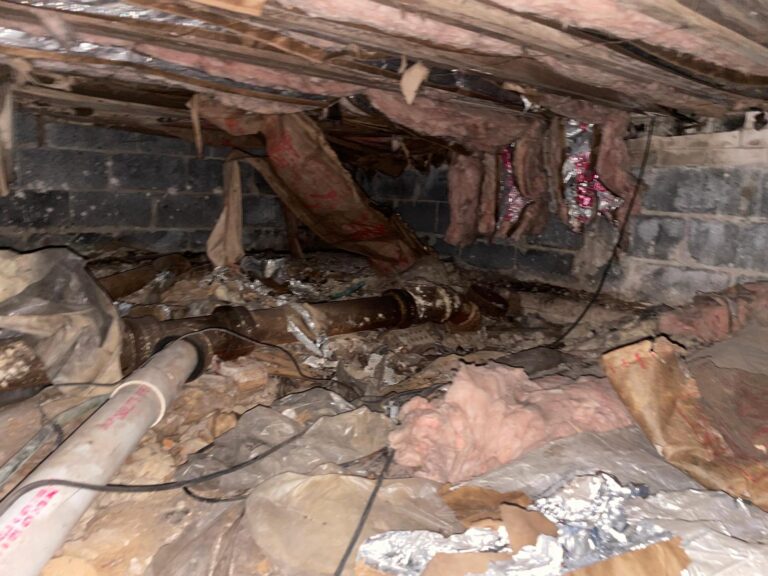
Start outside. Where do gutters and downspouts release water? Does the ground slope toward the foundation or collect water beside a vent or access door? Inside, look for active water, damp soil, wall staining, wet insulation, plumbing leaks, condensation on ducts, and changes after rain. Record where and when the symptom appears. A musty smell alone cannot identify the source.
If framing is soft or floors sag, have the structural condition evaluated separately. Covering wet or damaged wood with new insulation does not repair it. Our crawl-space repair guide explains when moisture control and structural work need to be considered together.
When does a crawl-space perimeter drain make sense?
A drain is for liquid water that enters or collects along a defined route. Depending on the site, an exterior runoff correction may solve the problem before an interior trench is needed. If water is reaching the crawl-space perimeter, a designed drain can collect it and direct it to an appropriate outlet or sump basin. The trench depth, pipe, filter fabric, stone, slope, and outlet must be specified for that property; a line of gravel with nowhere to discharge is not a complete drainage plan.
A ground liner controls vapor rising from soil. It is not a substitute for fixing standing water beneath it. See our crawl-space encapsulation guide for the distinct roles of the liner, air sealing, insulation, and humidity control.
Do you need a sump pump?
Only if collected water cannot be discharged safely by gravity, or if the site design calls for pumping. A pump needs a suitable basin, power, service access, and a discharge route that does not return water to the house or create a problem for a neighbor. Backup power may be appropriate where an outage during a storm would leave the home vulnerable. A sump should not be included automatically in every crawl-space quote.
Is a vapor barrier enough for a damp crawl space?
It may be, if the main issue is vapor from exposed soil and there is no active liquid-water entry. The liner needs durable material, sealed seams, and careful treatment at walls, piers, and penetrations. If rainwater or a plumbing leak is still wetting the soil, address that source first. A clean-looking liner can hide an unresolved problem below it.
Should the vents be sealed and a dehumidifier installed?
Humid outdoor air can condense on cooler crawl-space surfaces, but vent treatment belongs to a complete air, insulation, moisture, and code-compliance plan. Closing vents without checking combustion appliances, drainage, insulation, and required conditioning can create a different problem. After water entry and air leakage are addressed, humidity measurements can show whether dedicated dehumidification is needed. Size the equipment and condensate route for the actual space rather than choosing a model from a generic checklist.
How much does crawl-space waterproofing cost in the DMV?
There is no reliable price from square footage alone. Access and clearance, demolition of wet materials, the source of water, trench length, outlet or sump design, electrical work, liner detailing, insulation, and any structural repairs all change the scope. Ask for an itemized written proposal that separates essential water control from optional finishing. A quote for a liner alone is not comparable to a quote that includes drainage and pumping.
Will this remove mold or increase home value?
Stopping the moisture source is necessary when mold or wood decay is present, but a drainage or liner installation is not proof of mold clearance. Damaged materials may require a separate remediation scope and, where appropriate, follow-up verification. We cannot promise a particular resale increase or an odor-free home from one system; the result depends on the diagnosed source and completed work.
What should you ask before signing a crawl-space proposal?
- Which observation shows where the water or humidity is coming from?
- What exterior runoff or plumbing corrections were considered first?
- If a drain is proposed, where does it collect water and where does it discharge?
- Is a sump necessary? How will it be powered, accessed, and maintained?
- What will be removed, sealed, insulated, or replaced—and what is excluded?
- Which permits or inspections apply to this exact scope?
- How will you document the finished system and evaluate it after rain?
For a crawl space in Rockville, Ashburn, Manassas, or elsewhere in the DMV, request an inspection and a property-specific written scope. We will trace the water path before recommending drainage, a liner, humidity control, or structural repair.