

How do you waterproof a basement? First identify where the water begins and how it reaches the room. Water at a window after a storm, moisture on a cold wall, and seepage at the wall-floor joint may look similar indoors but require different responses. A useful plan for a DC, Maryland, or Northern Virginia home starts with observations, a site inspection, and a clear discharge route—not a standard seven-step package.
Step 1: Record when and where the basement gets wet
Photograph the first wet spot before cleanup. Note whether it follows heavy rain, a plumbing event, or humid weather; whether the wet area is at one opening or along several walls; and whether a sump pump runs. Check for active leaks from supply lines, drains, HVAC equipment, or condensation before assuming groundwater. A moisture stain alone does not establish the source.
Step 2: Check the water outside the house
During or soon after rain, look at gutter overflow, downspout outlets, puddles, hardscape slope, planting beds, and window wells. Surface runoff concentrated beside a foundation can often be addressed before intrusive basement work. Any regrading or yard drain needs an appropriate outlet and must not send water onto a neighboring property. A shallow grading drain is not the same thing as a footing-level foundation drain.
Step 3: Identify the actual entry path
Common paths include window openings, utility penetrations, wall cracks, construction joints, porous or deteriorated masonry, the wall-floor joint, and cracks in the slab. Water can also travel behind finishes and appear away from its entry point. Foundation material matters: poured concrete, CMU block, brick, and stone do not all respond to the same repair. A displaced or growing crack or bowed wall calls for structural evaluation, not simply a waterproofing coating.
Step 4: Match the repair to the water path
- Roof runoff or yard flow: correct the verified surface-water path through gutter repair, downspout routing, grading, or a suitable yard drainage system.
- Accessible exterior wall leak: consider exterior wall repair and waterproofing where excavation is feasible and the wall condition supports it. The scope should specify preparation, membrane, termination, protection, and restoration.
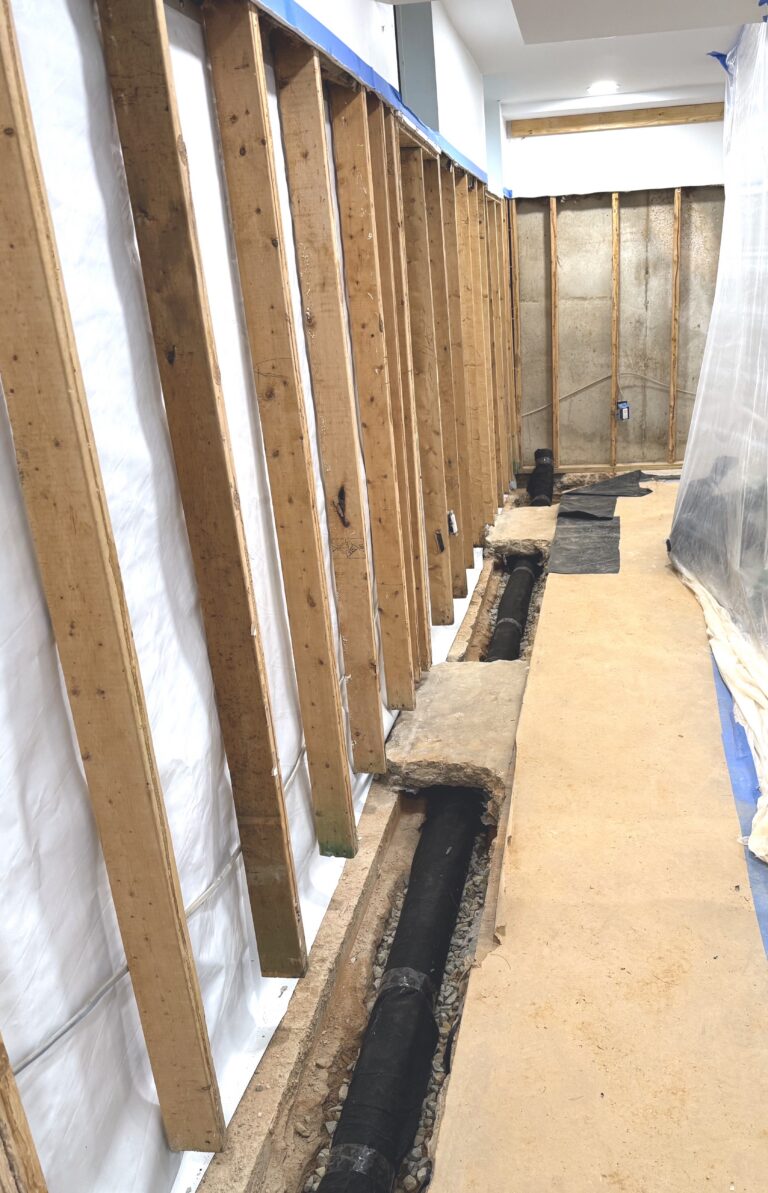
- Seepage at the basement perimeter: an interior collection drain and sump may be appropriate when water accumulates at the wall-floor edge, especially if exterior access is limited. The drain collects and removes water; it is not a substitute for fixing an avoidable downspout problem.
- Local crack or penetration: repair the specific opening only after identifying the wall material, movement, and water source. Injection is not the universal answer for every crack.
- High indoor humidity without liquid entry: control the moisture source, air leakage, and ventilation or dehumidification needs. A sump pump does not solve condensation.
See our interior versus exterior waterproofing comparison for the access and trade-offs of the two approaches.
Step 5: Specify drainage and discharge
If a drain or pump is proposed, ask where it collects water, how it reaches a basin or gravity outlet, where the discharge ends, and how backflow or freezing will be addressed. A battery backup is a separate risk decision, not an automatic part of every basement job. A buried line at near-grade and a drain at the footing are different systems; the drawing and photos should make the depth clear. Any dry well or outfall needs site-specific evaluation, not an assumed distance that works on every lot.
Step 6: Understand what must be opened and restored
A finished basement may require selective removal of wall finishes or flooring to inspect the wet area or install an interior drain. Exterior work may affect patios, steps, utilities, landscaping, and access. The written scope should explain what is included in protection, excavation, wall preparation, drainage, concrete, finishes, and cleanup. Ask for a realistic schedule based on that scope rather than a generic number of days.
Step 7: Verify the repair and maintain the system
Before closing the job, document the installed components and the visible outlet, test pump operation where applicable, and record any remaining uncertainty. Subsequent rain is useful evidence, but one dry storm does not prove every future condition. Keep gutters and outlets clear, follow the equipment maintenance instructions, and contact the contractor if water reappears.
What does basement waterproofing cost?
There is no responsible single price for a wet basement without knowing the water source, access, length and depth of work, discharge, utilities, and restoration. Compare written scopes that describe those items. A low quote that omits the outlet or finished-wall restoration is not directly comparable with a complete one. Ask what is excluded, what the warranty actually covers, and what happens if the diagnosis changes after the wall or floor is opened.
Questions to ask a basement waterproofing contractor
- What evidence identifies the source and the entry path?
- Why does this repair fit this foundation material and the observed water pattern?
- Is the proposed drain at yard grade, along the interior perimeter, or at footing level?
- Where will collected water discharge, and how is that location verified?
- What areas will be opened, what will be restored, and who is responsible?
- What observations or tests will confirm the work, and what does the written warranty cover?
Frequently asked questions
Can I waterproof a basement myself?
Simple maintenance such as clearing gutters or correcting a loose downspout extension may be manageable. Active seepage, excavation, pump wiring, significant cracks, or structural movement need a qualified site assessment. Painting over a damp wall without finding the water source can hide an ongoing problem.
Do I need an interior drain or exterior waterproofing?
Neither should be prescribed from a photo alone. An interior drain collects water at the basement edge; exterior waterproofing treats an accessible outside wall. The source, wall condition, access, disruption, and outlet determine the choice.
Will a dehumidifier stop a basement leak?
No. It can reduce airborne moisture but does not stop liquid water entering through a wall, window, or floor. If liquid water is present, trace and address its path first.
Will every finished basement need demolition?
No, but inspection or drain installation may require selective access. The exact removal and restoration should be in the written scope before work begins.
Need a site-specific plan? Request an inspection and share photos of the first wet area and the exterior during rain.