

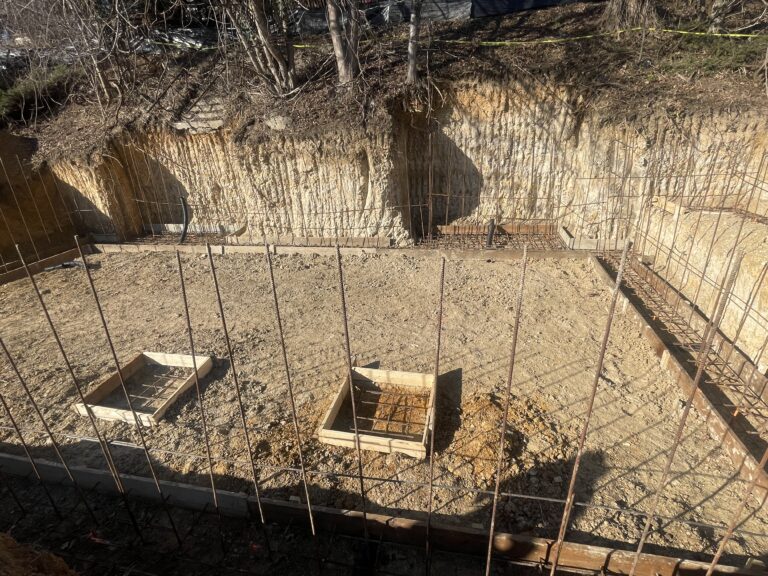
Post #2 in the DMV Waterproofing Field Notes series. Last week we talked about DMV foundation types. Today we go underneath — to the soil your foundation sits on, and the water table beneath it.
DMV soil and water table conditions are the single biggest reason two identical homes on the same street leak completely differently. One homeowner calls us because their basement floods in every spring rainstorm. Their neighbor — same builder, same year, same floor plan, same roof, same gutters — has been dry for thirty years. How?
The answer is almost always underneath the house, not above it. Soil type, water table depth, and grading decide whether your basement stays dry. Understanding what’s under your foundation is step two in understanding your water problem.
DMV Soil and Water Table: The Big Picture
Before we break down the details, here’s the one-paragraph version every DMV homeowner should understand:
The DMV is a wet, clay-heavy region. We sit between the Potomac River, the Anacostia, countless tributaries, the Chesapeake Bay, and an Atlantic coastline. Groundwater is everywhere. Our natural soil is predominantly clay, which holds water instead of letting it drain away. When a heavy rain hits — or when it rains for two days straight — the soil around your foundation reaches saturation fast. Once saturated, that soil pushes water toward the lowest point it can reach, which is almost always your basement wall or floor.
You don’t need to memorize soil science. You just need to understand two things about DMV soil and water table conditions: your soil is probably clay, and water in the DMV doesn’t drain the way it does in drier parts of the country. Everything else follows from there.
DMV Soil and Water Table #1: The Four Soil Types You Have
Across DC, Maryland, and Virginia, we see four main soil types. Each behaves completely differently when it gets wet.
Clay. This is the dominant natural soil across the DMV. The entire region sits on the Piedmont Plateau — ancient, weathered, iron-rich red clay soils that stretch across Montgomery County, Prince George’s County, Fairfax, Loudoun, and Prince William.
Clay is the problem soil. Here’s why:
- Poor drainage. Water can barely pass through clay. Instead of soaking down into the earth, water sits against your foundation wall and pushes its way toward the weakest point — usually your basement.
- Expansion when wet. Saturated clay swells. It pushes against your foundation walls with real lateral force.
- Shrinkage when dry. As clay dries, it contracts and pulls away from the wall. During the next rain, water flows straight down that gap — right to the footing.
- Doesn’t compact well. This matters enormously for exterior waterproofing. Clay is difficult to compact properly during backfilling. If the contractor doesn’t use a compactor correctly, the loose clay settles over time, pulls away from the wall, and creates new paths for water to reach the foundation.
- Like a gel. Moist clay behaves like a gel that moves with seasonal cycles. The soil around your foundation is never truly stable.
You can check the official soil classification at your exact property on the USDA Soil Survey. Type in your address and you’ll see the soil map of your lot — most DMV homes sit on some variation of clay and silt loam.
Silt. Silt is fine-grained, deposited by moving water over centuries. You’ll find it along the Potomac River corridor, the Anacostia watershed, old floodplains, and along creek beds. As water flowed through these areas, it carried the fine silt particles and dropped the heavier material as gravel, leaving a mixed but well-sorted deposit.
Silt is a much better soil to work with:
- Moderate drainage. Water moves through silt at a reasonable rate. It doesn’t drain as fast as sand, but it doesn’t trap water the way clay does. Water makes its way down into the earth instead of pooling near the foundation.
- Compacts well. This is why silt is the preferred engineered fill material. When a contractor backfills against a waterproofed foundation wall, silty soil compacts tightly, stays in place, and keeps the protection board and membrane pressed against the wall the way they should be.
Sand. Sandy soil is concentrated closer to water — Chesapeake Bay shorelines (especially Anne Arundel and Calvert County), riverfronts, and parts of the Coastal Plain extending east. Sand drains almost instantly. Water passes through within minutes. Great for foundations, bad for landscaping (plants need frequent watering).
Fill soil. This is the wildcard. Much of the historic DC area doesn’t sit on natural soil anymore. Over the last two centuries, construction has excavated, moved, and replaced the original ground with fill soil — a mix of whatever was available, including old construction debris, soil from other sites, and various natural materials. Fill soil is unpredictable. On a single city block, water may behave completely differently from house to house because what’s underneath is not uniform.
DMV Soil and Water Table #2: Why Clay Soil Is the DMV’s Biggest Problem
If there’s one reason the DMV is harder on foundations than most of the country, it’s clay. The same soil that makes our region’s forests so green is the soil that cracks our basement walls and sends water toward our homes.
Here’s the full picture of clay soil through the year:
Spring rains. The clay absorbs enormous amounts of water. It swells. Its volume increases. The saturated, expanded clay pushes against your foundation wall with lateral force. Over decades, this pressure is a major cause of horizontal cracks, bowing walls, and step cracks in CMU foundations. At the same time, because clay drains so slowly, the water can’t escape downward. Instead of soaking into the earth, it sits against your foundation and pushes its way through the first weakness it finds.
Summer dry spells. The clay shrinks. It pulls away from the foundation wall. A gap forms between the soil and the wall. Now when the next rain comes, the water doesn’t need to seep through the clay — it runs straight down that gap, right to the footing, where it causes the most damage.
Freeze-thaw in winter. Saturated clay expands when it freezes. Another cycle of pressure on the wall. Another cycle of stress on the foundation.
This is why Maryland basements — sitting on heavy clay — often have more severe water problems than Virginia basements with mixed loam soils only a few miles away. The geology changes, and so do the problems.
And this is also why drainage and compaction matter so much. In silty soil, water naturally moves downward and away from your foundation. In clay soil, nothing moves downward on its own — so proper drainage systems and properly compacted backfill are the only way to force water away from the foundation. Without them, water stays exactly where it doesn’t belong: pressed against your basement wall.
DMV Soil and Water Table #3: What Is the Water Table?
The water table is the depth at which the ground is permanently saturated — the level below which the soil is always holding water. Above that line, the soil can dry out. Below it, water is always present.
Across the DMV, the water table generally sits at 3 to 10 feet below the surface. Near rivers and creeks — along the Potomac, the Anacostia, and their tributaries — it can be as shallow as 1 to 5 feet. In higher-elevation areas, it drops to 10 feet or deeper.
It also moves with the seasons. During spring rains, the water table typically rises 1 to 3 feet. That seasonal rise is exactly when we see the most basement flooding calls in April, May, and June. After two days of steady rain, clay soils across the DMV reach saturation fast — and the water table effectively rises even faster.
Why the water table matters for your basement:
- If your basement floor sits above the water table → you may have surface water problems, but groundwater isn’t actively pushing up from below.
- If your basement floor sits at or below the water table → you have constant hydrostatic pressure pushing groundwater up through the footing, through cracks, through wall-floor joints. No exterior wall repair will stop this. The only solution is an interior drain tile and sump pump system.
This is why a proper inspection measures water table depth. You cannot guess. The same basement that looks fine in August can flood in April when the water table rises three feet.
DMV Soil and Water Table #4: Hydrostatic Pressure — The Force Nobody Sees
Hydrostatic pressure is the force that saturated soil and groundwater apply against your foundation walls. It’s not hypothetical. It’s measurable physics.
The numbers are simple. One foot of water creates approximately 0.43 psi of pressure. At six feet of saturated soil depth — a common basement wall height — that’s 2.6 psi of continuous force pressing against every square inch of your foundation wall. For a wall that’s 30 feet long and 8 feet tall, that adds up to tens of thousands of pounds of sustained pressure.
Over time, this pressure finds the weakest point. It cracks concrete. It pushes up slabs. It exploits mortar joints. It widens cold joints. The wall doesn’t fail all at once — it fails over years of continuous load.
Water enters where the wall is weakest:
- Wall cracks (even hairline cracks become highways for pressurized water)
- The wall-floor joint (cove joint) — the most common entry point in any basement
- Pipe penetrations and utility entries
- Cold joints between footing and wall
- Form tie holes in poured concrete
- Mortar joints in CMU, brick, or stone walls
DMV Soil and Water Table #5: Why Two Identical Homes Leak Differently
Here’s the scenario we see constantly. Same subdivision. Same builder. Same year of construction. Same roof design. Same gutters. One house floods every spring. The other has been dry for thirty years.
The reason is almost never in the house itself. It’s in the ground.
Small grading differences matter enormously. A one- or two-foot difference in yard slope between two neighboring lots can be the difference between water running away from a foundation and water running toward it. Builders don’t always finish grading the same way on every lot. Landscaping done years later by different homeowners changes the grading further. Over thirty years, those small differences add up.
Soil type varies across short distances. The neighbor’s lot might be slightly more clay-heavy, or slightly more loamy. On fill soil — especially in older DC neighborhoods — the composition literally changes from house to house.
Backfill quality varies too. When the original builder backfilled against the foundation walls, some lots got properly compacted silty fill. Others got loose clay dumped in without careful compaction. Thirty years later, the difference shows up as water problems in one house and dry walls in another.
Downspouts tell their own story. One house may have downspout extensions that carry water ten feet away from the foundation. The next-door house may have them dumping at the wall. Same rainfall, different outcome.
Uphill matters too. If there’s a slope above your home, water from upper lots may be flowing down to your foundation long before it ever reaches your own gutters. Your neighbor’s yard is part of your water problem — and you can’t see it from your basement.
DMV Soil and Water Table: Maryland vs Virginia vs DC
There are real regional differences within the DMV.
Maryland — especially Montgomery and Prince George’s County — sits on heavier clay. Water penetrates the soil slowly. It collects near the surface and around foundations. Hydrostatic pressure is more common.
Northern Virginia has clay too, but in some areas (particularly moving west) the soil is more balanced with loamy deposits. Drainage is slightly better in these pockets. Still the same region, still the same Piedmont geology — but with local variation.
Historic DC is its own story. The natural soil in most of the district has been disturbed, excavated, and replaced with fill soil for two centuries. Fill soil is unpredictable — old construction debris, mixed material, inconsistent compaction. Even on a single block, water behavior can vary dramatically from house to house.
Near the rivers — along the Potomac, Anacostia, and their tributaries — the water table sits much higher, often 1 to 5 feet. Homes with basements in these zones face constant hydrostatic pressure. On higher ground, the water table drops and the risk decreases, though surface water and clay expansion problems remain.
What You Actually Need to Remember
You don’t need to become a soil scientist to understand DMV soil and water table conditions. You just need three ideas:
- Your soil is probably clay. Most of the DMV sits on heavy clay that holds water instead of draining it away. That alone makes your basement more vulnerable than most.
- Your water table is probably higher than you think. Especially in spring, when heavy rains raise groundwater levels. And if you live near a river, creek, or low-lying area, it was high to begin with.
- Two days of rain is enough. In clay-heavy DMV soil, it doesn’t take a hurricane. After two full days of steady rain, the soil around your foundation is saturated — and water is looking for the nearest path to your basement.
That’s the whole DMV soil and water table picture. Your soil holds water. Your water table is close. When it rains for two days, the soil saturates fast and pressure builds against your foundation. Everything we do as waterproofing engineers is designed to interrupt that chain — either stopping water before it reaches the wall (exterior systems), or safely removing it once it arrives (interior systems).
Next week, we’ll go deeper into how water gets into your basement — the specific paths it uses, the weak points that let it in, and how different failures look from the inside.
— The founders of DMV Waterproofing
Want to Know What Your Soil and Water Table Look Like?
Our free inspections include a diagnostic walk-through of your foundation, soil type, drainage pattern, and water entry points. No subcontractors, no sales pressure — just an engineer-trained inspector diagnosing what is actually going on.
Or call 1-833-888-2533 to speak with a project manager directly.


![[GetPaidStock.com]-680786795b816 [GetPaidStock.com]-680786795b816](https://dmvwp.com/wp-content/uploads/2025/04/GetPaidStock.com-680786795b816-370x418.jpg)
